
Discrete as I wanna be.
Wednesday, February 11, 02026
13 in the line up (plus me and Seth—do we count?)
An oldie but a goodie, as they say. Last night we tackled “Is there such a thing as freewill?” Thank you, Thom, for bringing your curiosity about freewill to the table. I was back in action, notebook in hand, pencil sharpened, ready to take down the broad strokes of the conversation.
Seth Set the Table
We often think of a self that makes choices, and those choices are what makes our freewill—agency that's not interfered with.The problem is it's not clear that all these options we think we're choosing from are actually possible. Because of determinism. The idea that everything that could be, has been, and always will be. This is referred to as hard determinism. There’s no chance and further there’s no change. If determinism is what makes the cosmos tick, then freewill couldn't exist.
But there are some approaches to thinking about freewill. One is the idea that causality isn't necessarily real. Or that freedom of will doesn't have to do with choices—instead it could have to do with being at ease with the world, like the Stoics thought. Freewill as acclimation. And another approach: simply, what difference would it make?
Tim dove in first this time. Statistical physics reveals a stochastic world. Because the research exists showing this about determinism, Tim suggested we explore other aspects of freewill.
Bob wanted to know whether there was a difference between the philosophical concept of determinism and the physical or scientific concept of determinism. Then he announced—as if we didn't already know—that he's a complexity guy. He really loves how complexity can explain many of the conundrums that come up. I love how Bob roots for complexity, like it’s his home team. Ride or die complexity!
He went on to say we could live in a deterministic world, but it would never seem like it. We could have physical determinism, but it’s not clear what difference it would make or what we would do with that understanding. For example: if we knew all the points of data about the weather, we could very easily say what the next moment of weather would be like, it operates in a closed system and we understand all of the variables that apply to any given weather condition. However, because of who we are and how much data that would require, it never really feels or presents like it's deterministic.
Philosophy and science sitting in a tree
Seth said the philosophical idea of determinism is the precursor to the scientific definition. It's both broader and vaguer. Depending on what cosmology (not to be confused with cosmetology. Maybe it’s Mabeline, maybe it’s Chaos) you adhere to, the gist is that everything that is has a necessary set of conditions that make it possible. Determinism in the Western context—and Seth was very specific that this is only the Western context—sets us up for understanding determinism in a sequential way. The trouble is this way of thinking leads us to philosophers all the way down. Because every set of necessary conditions also has it’s own set of necessary conditions in order to exist (and please forgive the use of the word exist here, our language lends itself to presuming some specific ideas ontologically…but here I am getting in the linguistic weeds and all the jargon. So, I guess please excuse that too?)
The thing is western thinking sets us up to require an emphasis on either the individual and their perception exerting will and shaping everything or the cosmos impacting the individual, making the individual possible and shaping it along the way.
Jon brought up the Double Slit Experiment, leading the group to consider the role of consciousness in the question of freewill. Bob thought no way, if consciousness was causing the cosmos, then we'd all see a different world, right?
This video explains the double slit experiment, and mentions that consciousness having an impact on physics is no longer an opinion still held by the physics community. Then is unpacks all of the weird stuff the experiment still shows us and the questions that remain.
While science has moved on from the idea of a “special nature of human consciousness.” Philosophy has room to consider what science cannot due to different scopes, approaches, and practices of the fields. Everybody’s still in the dark about what consciousness is anyway, let alone any one species version of it. I’m team plant minds. (Go big Granite, iyky).
Seth lifted up the question: is it the world making the mind, or the mind making the world? If my mind is shaping the world, then I must have access to my mind—and all of its workings—in order to have freewill. If we imagine a person with the power of a God that could shape everything, it's still not clear that freewill is happening. The problem is we’re still left with the question of what motivated the decisions in the first place? If it’s random it doesn’t seem to be an issue of freewill cause there’s no intention and if there’s a reason for it, the intentionality wouldn’t arise from you. So even someone with the power of a god may not be free, because the freedom may not be attached to them.
Dale also thought it unlikely that consciousness could make the world. Seth quipped, "I imagined you'd say that."
Then Dale shared he’d been reading about a girl who had been an alcoholic and started taking Ozempic, and the desire to drink just went away. And another example of somebody who had Parkinson's, and the medication she was on led to a really bad gambling problem. Seth added: Harvey Milk's killer said the Twinkies made him do it.
They're all anecdotes to consider how much freewill is possible. And how some examples are easier to swallow as freewill or determinism than others.
Seth asked the group, “if there's such a thing as freewill, what is the "I" that makes the choice?” Philosophers man. Always with the questions.
Hormones, Epigenetics, and Factors
David spent some time researching before he came tonight. He avoided looking into determinism because he figured that would just be brought up anyway. He came across a couple of thinkers: Galen Strawson and Robert Sapolsky. Strawson's ideas are interesting because there are a bunch of things in our personality that we have no control over. Sapolsky sees something similar in how much epigenetics or hormones impact the choices we make. So it raises the question, how much are we making our own choices if so many factors are influencing us all the time?
David didn't think it made it impossible to be in control of our own choices, but he could see how these factors weighted our decisions. He's not entirely on board with the idea that they're already predetermined.
If you want to go down a Sapolsky rabbit hole. There’s an entire series of his lectures from Stanford on YouTube here:
Sapolsky mid blink.
Seth wondered: what exactly does it mean to be a factor?
What makes something a factor versus a cause? A weight versus a determination?
Lessons in Self-i-ness
Jan wanted to know more about the Western versus non-Western ideas Seth had mentioned earlier. Is it a definition of freewill or of consciousness that changes?
Seth put on his teacher hat and this is what we got.
There are ideas about what the self is that are peculiar to the Western tradition—that individuals are discrete and self-contained. In many other traditions, they don't do it that way. Yes, there are individuals, but that doesn't mean the "you" that makes you follows those same conditions.
In classical Confucian thought, while there are individuals, individuality isn't the central component of the identity of the self. Rather, identity emerges by virtue of the dynamics and interactions between those individuals. It's a little like a pitch, or a rhythm, or harmony that exists between them and emerges with a kind of meaningful resonance.
In Brahminic thought, the individual self is merely an expression or manifestation of the fundamental condition of the absolute self, which gives rise to identity, which gives rise to the possibility of anyone being anything. The image often given is this: in the same way that a facet of a gemstone reflects the light within the totality of the gemstone but isn't independent from it—it's just an expression of it—so it is that the individual is an expression of the absolute self. The Atman.
In Buddhism, one of the central premises is there is no such thing as a self. The self is a sort of combination of different elements or entities that give rise to an expression of individuality, an expression of ideas. But there's nothing fundamentally about this that makes "self" self. In fact, the notion of self is a delusion. Which is why Buddhists refer to anatman—the no-self—as the fundamental condition.
In Western thought, freewill has a big impact on identity. But if the idea of the self is emergent, then there are totally different implications on the nature of freewill. And the self becomes less important.
So if you're not a discrete, self-contained individual making choices, then what does freewill look like?
Magic breaks our brains
Tim is interested in cognitive psychology, determinism, and the disruptions that we call magicians. He’s interested in our ideas about social pressures versus freedom.
Dale followed this thought with considering our success as a species because of our ability to connect cause and effect. It gave us an evolutionary advantage. And magic breaks the idea of cause and effect.
Seth mentioned it was too bad Jane wasn't here, because The Spell of the Sensuous is one of her favorite books. It talks a lot about animism, mysticism, and takes a phenomenological approach to thinking about these ideas. The connection comes from the fact that Abrams—the author—started down these lines of thinking because he himself was a magician.
Some more examples of thinkers came up. Bob mentioned Francis Fukuyama. Tim mentioned the great scholar Joplin.
Me and Bobby McGee - written by Kris Kristofferson, a philosophy major.
But Why Do We Care?
Seth asked: Why do we care about freewill?
Don thinks it's because the question has to do with our own decisions. Can I help or make decisions? He wanted to clarify the intent of Thom asking the question. There was some back and forth about whether he was referring to Thom or Tim. Both in his line of sight and both had brought up different questions, but Thom is the one who was interested in the topic of the evening. He said he was curious about whether we are constrained by fate or divine will. That's what he was trying to ask.
Seth told us a story about a student who decided on his third day of philosophy classes to major in philosophy because they recognized the question "What does fate mean to me?" would be a question they'd ask themselves every single day.
Don then regaled us with a retelling of Conrad's book Victory (This links to the entire book which was published in 1924. Be prepared for exactly the amount of sexism and racism that would have been commonplace at that time if you click the link to read it) and how the premise deals with fate and trying to escape the fates. In a particular scene, a character thinks they can safely escape the fates. However, the fates follow.
The group wanted to know what happened.
Don said, "I'm not going to give the story away." (after telling most of the story).
David mentioned, "I don't think we need a spoiler alert for a book that's over 100 years old."
Finding Comfort in Having No Choice
And this is where I jumped in with something I've been thinking about for a long time.
I like the idea of determinism. I find it comforting. When my mind goes in a million different directions and I worry about what's going on in the world, or think about something I said 20 years ago that I should have said differently, and then my mind just keeps going and going and going... I find determinism is a comfort.
Because in order for all of it to be possible the good, the joyous, all the wonder requires those other parts that feel terrible, the only way that all of it is possible is if all of it is. I do have a soft spot for the Stoic ideas in this regard.
It's disheartening to me to think that when these terrible atrocities happen in our world, it's merely some person who had the freewill to say, "Maybe genocide is a good idea today."
Seth talked about ataraxia—the Stoic approach, as a kind of therapy on how to be in the world. Unperturbedness.
Tim mentioned his fascination with religion.
Bob whispered, "He steals all of my ideas before I get to say them." It's been fun watching Tim and Bob enjoy each other.
Tim continued: Heaven and hell are particular to Abrahamic religions, especially the post apocalyptic part. And these ideas require freewill. You cannot have those religions without the concept of freewill. So it's cooked into the culture.
But What About Morality?
Tim and I then exchanged thoughts on how morality works within determinism or freewill. Because I don't think determinism frees you from responsibility or moral agency. It just works different.
He pushed back saying you're a determinist. If everything is already decided, then there's no autonomy within it. How do morals exist?"
I responded that, "I also mentioned I worry all the time. I think about all these other possibilities in the world. I'm experiencing that, too, in spite of the idea that I find determinism comforting. Even if everything is determined, we are still the vessels through which actions and roles are functioning. We're still experiencing all the feelings associated with those acts whether or not they were determined. We are still experiencing morality. Responsibility looks a little different in the grand scheme of things, but it doesn't disappear per se."
Bob also had thoughts on determinism and its relationship with religion. The idea that God is the reason for anything/everything happening is not satisfying at all, especially because it takes away the possibility of complexity.
We interrupt this reflection for an important message from Bob.
Seth mentioned it's interesting why in some cases either freewill or determinism is confounding, and in other ways it's satisfying.
Jan brought up freewill and original sin, and a discussion she had with her four-year-old nephew about theology. This little person saw that God only cares about people when they're sad, broken, or dead.
Out of the mouths of babes.
Seth brought up what a great instinct discussing religion is—because it muddies more than just morality. It takes things and ideas and uses them as instruments, when it's done poorly, for its own purposes.
Bob wanted to put an ad out for taking Seth's philosophy of religion courses. They didn't entirely change his life, but the course can be almost life-changing.
Half-Baked
What exactly is a "factor"? A factor versus a cause. A weight versus a determination. If hormones and epigenetics are factors, what does that leave for the "I" that chooses?
If the self is emergent, then what does it mean to have freewill at all? Can a harmony have freewill? Can a facet choose?
Why is determinism comforting to some and terrifying to others? Why is freewill satisfying in some contexts and confounding in others?
Jan's nephew's theology. God only cares when you're sad, broken, or dead. What does that say about how we construct meaning around suffering and agency?
What We Know We Don't Know
The conversation kept circling back to this: if you change what you mean by "self," you change what you mean by "freewill." The Western idea of a discrete, self-contained individual making autonomous choices is just one way to think about it. And maybe not even the most coherent way.
But we're still here, experiencing choice, experiencing responsibility, experiencing morality. Even if I find determinism comforting, I still worry about things I said 20 years ago. Even if everything is determined, we're still the vessels through which it all flows. We're still experiencing it.
Maybe that's the point. Not whether freewill "exists" in some metaphysical sense, but what it means to be a creature that experiences choice, whether or not that choice is "free" in the way we typically think about it.
The question touches so much from morality, responsibility, religion, and identity, to the very nature of the self. Whether we're discrete individuals or expressions of something larger. Whether the cosmos makes us or we make the cosmos. Whether we're vessels or agents or both or neither.
Join us next week for "How is it possible to deceive ourselves?"
Big ups to Carol, Shanel, John, Jim, and Janeen for the thoughtful vibe. Listeners build the space too.
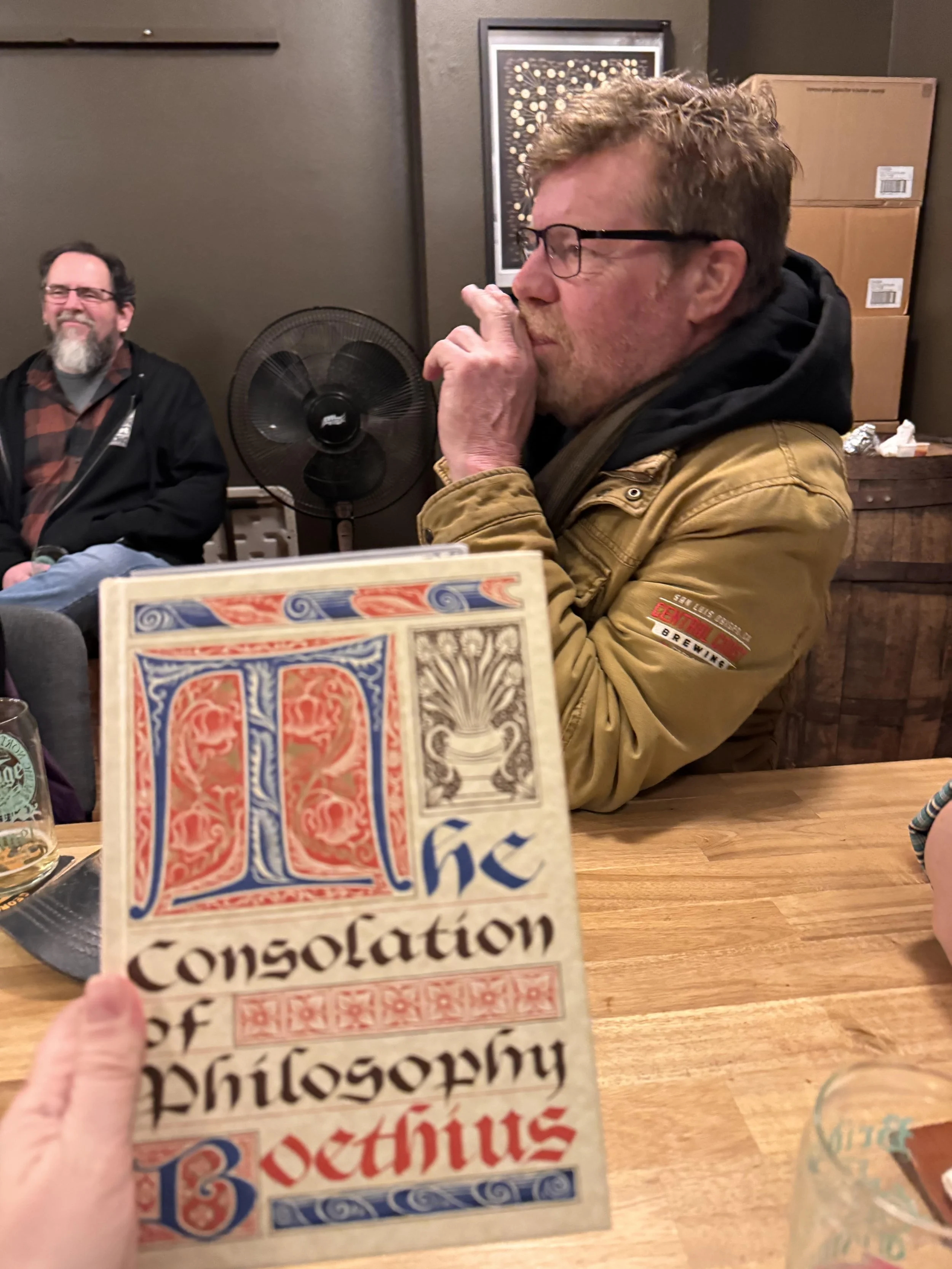
P.S. Did anybody notice Don was reading Boethius?
