
Uh oh everybody, we’re talking about religion. Plug your family’s ears and hide the link to this post.
More than one family was referenced this evening. I mean, the Moral Majority might not have name recognition for our younger Scoundrels, but our country certainly enjoys a spot of fundamentalism often in the form of a side eye at the holiday table. Speaking of which, should we eat more? Tacos are tasty, right?
Seth started the night the way he does when he teaches religion, by asking what it even is. I feel like there’s some kind of fun opportunity to build a definitions culture at Scoundrels/philosofarian. I don’t know if it's a definition flag, knocking like parliament when the word or idea comes up, maybe a torch. Or maybe, I’m nuts and that’s just TOO MUCH (not the first time I’ve been described that way) Let me know what you think we should or shouldn’t do.
Back on topic…as Seth was saying, students offer familiar answers. Faith. Ritual. Higher power. Tradition. Authority. But the thing is, each of those ideas has exceptions. If we can't even define what religion is, then what does it do? And why does it keep showing up in human consciousness?
Minding the Gaps
One way into that question came from Tim, who went for it as a first-timer. Gold star for participation. Drawing on work he’d done with psychologists, he talked about how uncomfortable humans are with gaps in understanding. We want closure. We want things to add up. His suggestion was that religion works and persists because it supplies a structure that fills the gaps for those of us who don’t want to deal with the gaps.
“Is that really what it does, though?” Ciera asked. Plenty of people she knows engage in religious practices precisely because they want to spend time with what they don’t understand. Religious practice is a way to explore or be with the gaps. It can be, but doesn’t have to be avoiding the gaps. We can be “minding the gap,” Bob chimed in. Wink, wink for the anglophiles.
Don offered a framing that helped organize the mess without tidying it up too much. Instead of one definition, maybe it’s helpful to have a handful. Religion shows up culturally, speculatively, and introspectively. Cultural forms bind people together through shared identity and practice. Speculative forms pull toward metaphysical commitments. Introspective forms look more like habits or disciplines of attention.
Seth pointed out that philosophers have noticed this pattern too. Different forms feed different human needs. You can participate in one without committing to all of them. People do this all the time, whether they name it that way or not. I thought it was cool Don had come up with a framework that philosophers had used. He was disappointed someone had already published it. It’s weird how we conflate novelty with intellectual worthiness, isn’t it? I think Don still did something interesting and smart, even if someone else had the idea too.
Jane’s take on why religion persists is, “If we’re the be-all and end-all, we’re in deep shit.” Frameworks help, whether they come from religion, art, science, or philosophy. Jane spends a lot of time considering questions around religion and leadership. As someone who is a “purveyor of practices” she thinks religion is one way to help people become the most personable they can be. Religion offers a way to wonder or consider when individual perspective runs out and to do it in a community.
Living With What We Can’t Know
Bruce brought up that there's something More that everybody knows is there. We have a longing to know the unknowable, and religion is one way we work with that. It's useful as a coping mechanism for dealing with what we can't know.
What does it mean to come to terms with the unknown? Bruce described it like waking from a nightmare—you realize what you're looking at is just a tiny subset of everything that's unknown. Some people need more help being comfortable with that than others.
Bob shared that he'd “sparsely attended” a class Seth taught about religion, and Seth introduced this idea that truth can be approached asymptotically—you can get closer and closer but never actually reach it. For Bob, this was life-changing. He dropped his angst about trying to attain truth. Just... let it be unreachable and keep moving toward it anyway. (take that, perfect attendance awards)
Tonia called religion a Swiss Army knife. It works in so many different ways precisely because it's a tool for working with unknowability. Sometimes it is an opiate for the masses, other times it’s a compass for the unknowable, it can do both of these things and many more.
Seth brought in Émile Durkheim and Clifford Geertz, who wrote about symbols and how they work in religion. Symbols give us access to parts of the world we wouldn't or couldn't have access to otherwise.
Tim was concerned Seth was saying that you can't form concepts or know anything without religion—that belief is required for knowledge, and belief requires religion.
Seth clarified: no, that's not what I'm saying. Consciousness deals with a broad scope. But you don't have to believe something in order to hold an idea or know anything. It's not a totalist horizon where everything requires a religious framework.
Tim seemed relieved or maybe relaxed a little with that cleared up.
But then—and this became a bit of a theme for the evening—he circled back to his original position. People use religion to avoid dealing with gaps in understanding. He brought up later that it seemed like Seth was trying to steer away from this position, it wasn’t what Seth was doing, but the idea was what Tim kept seeing.
It's worth noting Tim wasn't being aggressive about this. He was returning to it the way you do when an idea has a hook in you. Throughout the night, he'd come back to this notion that religion functions as avoidance for some people, even as others in the room offered nuance - it doesn’t only do that or examples of how it functions as engagement (it can be the opposite of avoidance).
When Not Knowing Becomes Unbearable
Andrew brought up how religion works so differently for different people. For some it answers all the questions. For others it helps them wonder and wander through the gaps Tim had been talking about. Religion is made of so many stories and rituals—thousands of ways to take shape, supposedly from one word of God, but with infinite ways to interpret that one word.
Seth brought in William James and The Varieties of Religious Experience. James was a pragmatist, which means whatever you're working through philosophically has to actually work in practice. Even if you come up with an idea that explains everything, if it doesn't work for human experience, then it doesn't actually work.
Seth traced the word "fundamentalism" specifically back to 1909—Presbyterians who wanted answers that couldn't be questioned. This was a response to modernism emerging in culture. People needed religion but had no idea how to do it in this new world.
We Didn’t Get Babel, We Got a Pyramid
Don started playing with the idea of achieving certainty (gap filling), and I sketched out this pyramid while he was talking. At the bottom: someone who's kind of spiritual. Above that: the appeal of an idea. Then with cults specifically, (“By the way you’ve been inspirational tonight, Seth”) you get layers of indoctrination building up, and at the very top: just one person.
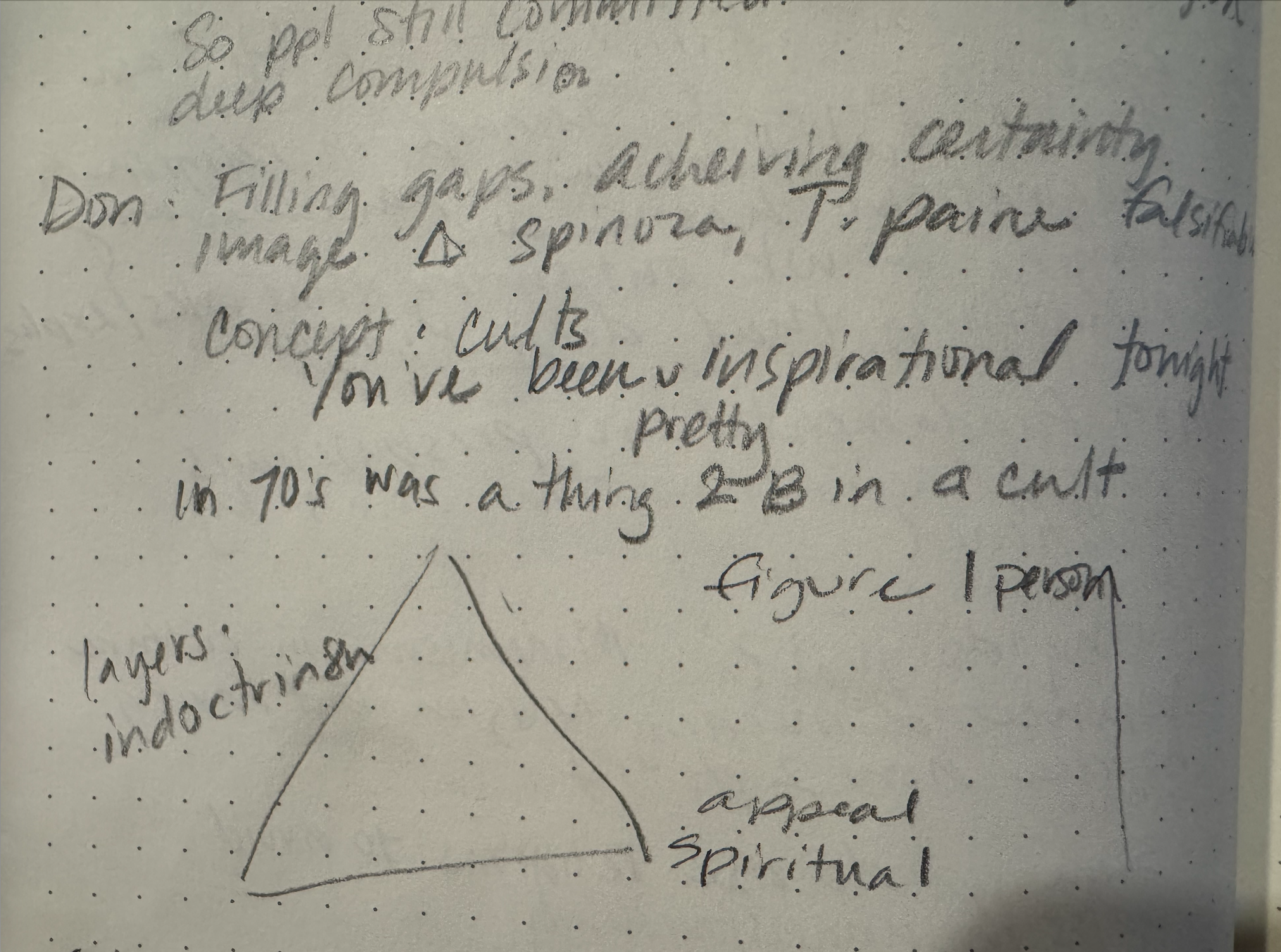
Beautiful scribbles on Don’s ideas. Gosh I’m an artist, look at that perspective.
He was thinking about Spinoza, Thomas Paine, and falsifiable concepts. Then Don compared religion to an old car. You know how vintage cars have all these issues? You've got to kick start them, get the timing right, maintain them in ways you just don't with a new car. But there's still something incredibly appealing about driving that vintage model. People don't just throw them away. He was probably talking about a sexier beast that this boy below. But, when he was talking about old cars my beloved Corolla came to mind.

Mine was more poop colored and had bondo holding it together.
Seth picking up on the cult thread shared that his specialization in comparative philosophy, has led several people over the years to ask him to weigh in on some guru or teacher they’re really getting into. He says the thing with cults is there's usually a pretty obvious hierarchy that gets used to explain how the cosmos works. Human drives get handled in very particular ways that either yield meaning or don't.
Tonia pointed out that with cults, the hierarchy often isn't obvious at first. There's a ramping up that happens. Seth agreed—there's reiteration, and narrowness comes in gradually.
Tim said, “There's a lot of angst in the world, and religion solves a lot of that angst.”
Seth asked Tim if he was familiar with Paul Tillich. "You bet I am," Tim said.
Seth unpacked a bit of Tillich's distinction between idolatry and angst for the group. I tried to map that one out too, but I think I lost some important connections. My hand wasn’t as fast as the ideas that were flying around the room. Anybody want to sign up as an idea cartographer?
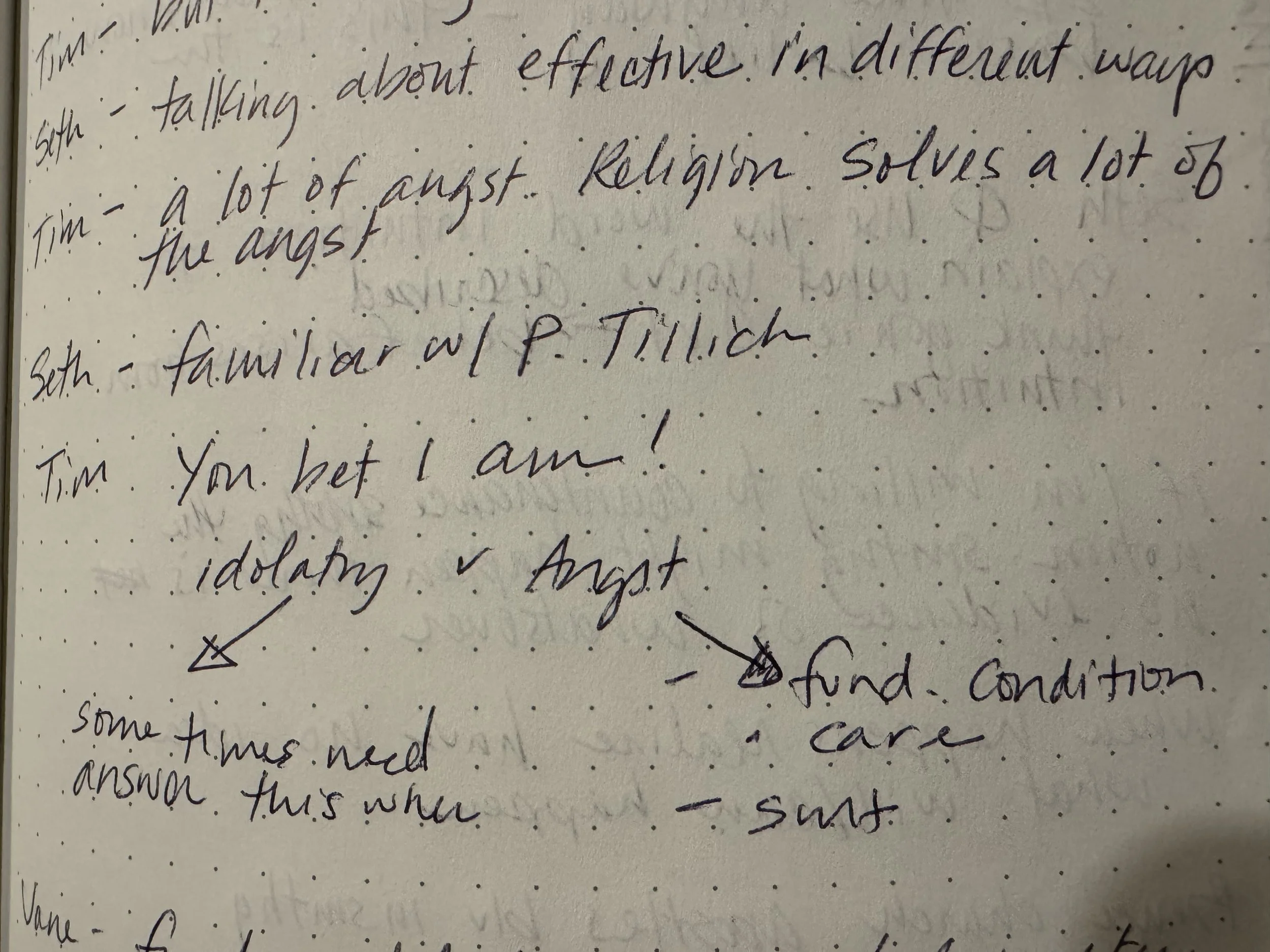
It literally says “something” as a note - why waste the time, lol?
Ahsha on Creativity and Frameworks
Ahsha said that twenty years ago, she would have been WAY more animated about this question.
"Amen, sister," Jane said, and people laughed. My 20 year old self probably would have rolled my eyes at the question and muttered something about…because they are idiots. Let’s just say filtering wasn’t a young Gad strong suit. Can I get a Hallelujah, holla back for growth?
But Ahsha, had hooked a big idea, she was thinking that religion gives us a framework for and may possibly be the foundation for creativity. We need to be in community with each other. And it's in that community that we have a framework for experiencing things. That framework lends itself to the capacity for wonder. It might even be what makes it possible to wonder in the first place.
She didn’t say this explicitly, but with this way of thinking Religion is the structure that makes wonder possible, not the thing that shuts it down.
Meaning Likes Company
Dale lamented that we didn't have hours and hours to talk about all the threads his mind wanted to follow. Same, Dale. Same.
Dale was coming from a perspective adjacent to Tim’s. We don’t need religion to explain, wonder, or think about the million upon trillions of star and connections and chains of events. We have physics.
Bruce referred to Seth as the philosophy rabbi of Astoria. Then shared his musings on the question of the evening. He thought if you take religion, throw out the money and the greed (‘cause it’s not stamped with Bruce-ness, if we don’t address the numbers and the money, y’all), and you're left with belief. You're left with what you could fathom that you otherwise could not. Sometimes there's an unknowable that we know to be true anyway. That's the basis for belief.
Seth said that's what philosophy calls intuition. And agreed he also thought belief arises from intuition.
Bruce kept going. There's something about being willing to contemplate that something might happen with absolutely no evidence whatsoever. When we do that, when we really sit with that possibility, we realize we have no idea what can or will ever happen.
That's where religion persists.
And I know Fawn brought this up before Bruce’s bit, but she wove a lot of interesting concepts together and I think it’s a nice note to leave off on. She said, we have this desire to see purpose and meaning in our own existence. Community is where we find belonging—it's where we can contribute and receive. There's a kind of circuitry in our desire for meaning and our need for belonging. The relationship between belonging and meaning. How does that work?
So why are people religious?
We didn’t land on a single reason. We talked about gaps and certainty, wonder and authority, creativity and community. About frameworks that help us live with what we can’t know, and structures that sometimes harden when not knowing feels unbearable.
And to end with a little pragmatic flourish perhaps we should ask: When you notice religion showing up in someone’s life, what do you think it’s helping them carry?
Scoundrels meets every Wednesday at 5:30pm at Bridge & Tunnel in Astoria. No expertise required, just curiosity. January’s questions will be equally impossible.
