
Jean-Paul Sartre famously wrote that "hell is other people." If he were alive in 2025, he’d probably update that to “hell is other people on social media.”
Every other week, we see another journalist or academic opining about the evils of social media: it has single-handedly polarized us, destroyed our ability to have real relationships, ruined our self-esteem, made us lonely and stressed out, and is generally on track to destroy human civilization.
Social media has its problems, but we believe there’s another reason so many people are struggling with loneliness and lack of connection right now—the decline of third spaces.
What is a third space?
First spaces are home. Second places are work. Third places are kind of magic. They're the coffee shops where regulars know your order, the brewery where you always bump into a friendly face, the revamped library where you can exist alongside strangers in comfortable silence. They're where we go to be among people without having to do anything for them.
Third spaces offer a special kind of togetherness—one that’s free of obligations and pretense. At home, you're in your castle with your rules and your dirty dishes. At work, you're being productive, managing relationships, optimizing your time. But in a third space? You get to just... be. No one's tracking your progress or judging your furniture choices.
The sociologist Ray Oldenburg, who coined the term "third space," understood that these places do crucial social work. They're social equalizers—the barista doesn't care if you're a CEO or a student. They're familiar without being routine. They offer what he called "playful interaction," which is a fancy way of saying you can talk to people without it being a thing.
What do third spaces have to do with philosophy?
Philosophy—not the ivory tower kind,the accessible, conversational, "let's think about this together" kind—thrives in third spaces. At Philosofarian, we host conversations in public places like coffee shops and breweries. Plato’s Academy wasn't a lecture hall; it was a grove where people walked and talked. The Stoics held their conversations in the Stoa (that’s a public community space). Every time you join a Scoundrels gathering or Wit & Wisdom talk, you’re participating in a rich tradition of public philosophy that goes all the way back to ancient Greece.
Third spaces are so philosophically potent because they create the conditions for genuine dialogue. At home, we're surrounded by our own echo chambers—literally, if you count the algorithm-curated content on our devices. At work, most conversations have agendas, outcomes, and stakeholders. But in a third space, you can bump up against ideas that aren't yours, perspectives that surprise you, and sometimes questions you didn't know you had—without any ulterior motive at all!
Third spaces are a place to wonder together
We're living through a major shift in what it means to converse. Online, we perform our positions for an invisible audience. In our homes, we retreat into comfort. At work, we stay professional and avoid the big questions. Where do we go to actually think together?
We believe the answer is third spaces. At Philosofarian, we design our philosophical conversations around the idea of structured informality. The structure gives permission—yes, it's okay to talk about meaning, purpose, ethics, the big stuff, and no one will think you’re weird for being curious about these things. The informality keeps it fun, human, and welcoming to all. We aren’t here to find the right answer or win a debate. We’re here to wonder together, to think alongside each other and build something neither of us could construct alone.
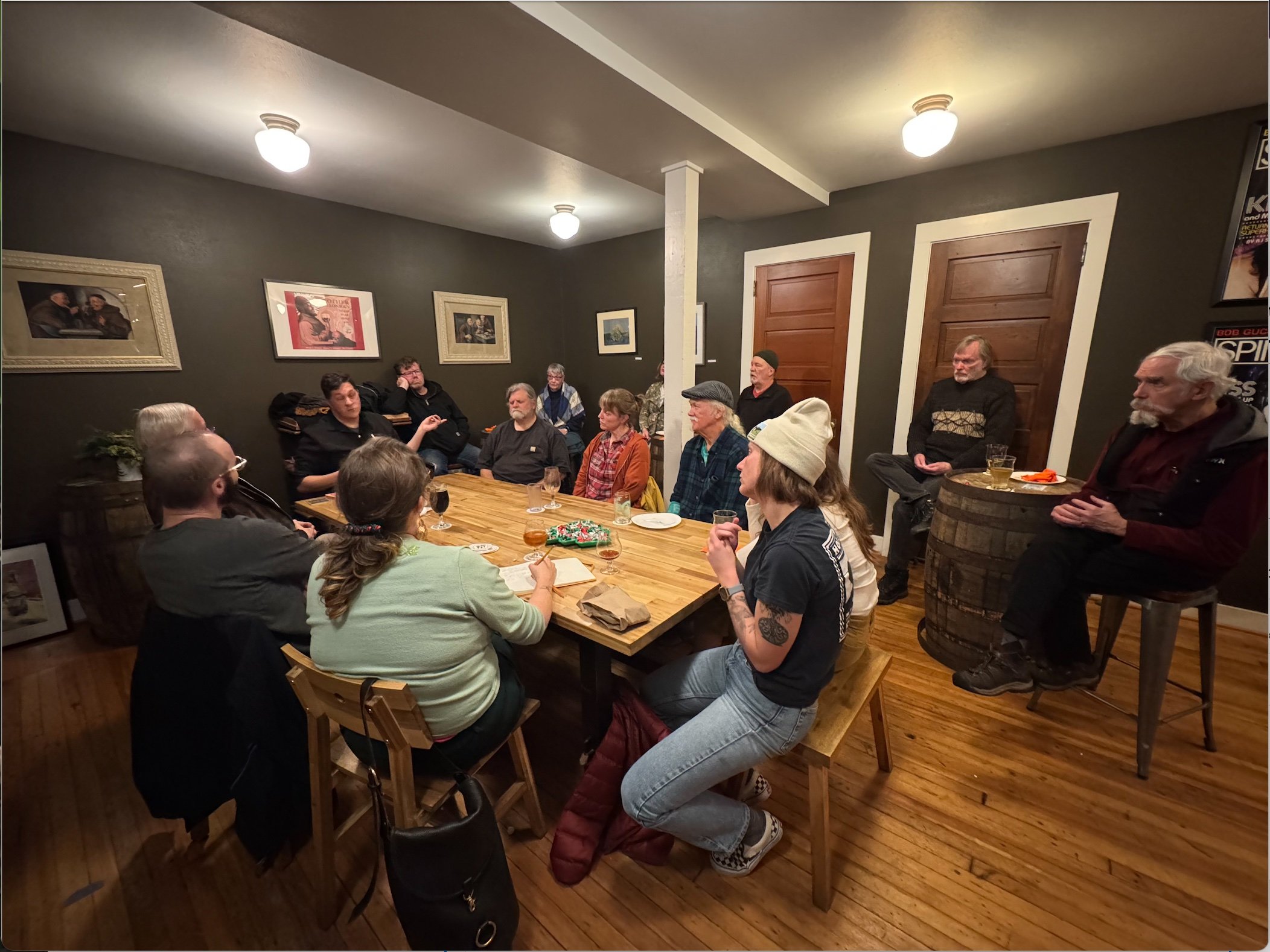
Scoundrels using Bridge and Tunnel for a third space
Why we need third spaces now
As a society, we’re feeling lonelier and more disconnected from each other than ever. Third spaces are a place to belong. So much becomes possible when we converse and wonder together. We can explore new ways of thinking and learn to change our minds. We discover potential we didn’t know we had, transform our understanding of the world and our place in it, and bring new ideas to life. We aren’t just changing ourselves when we do this; we’re changing what’s possible for our community in real, meaningful, tangible ways.
So here's the invitation: imagine a third space designed specifically for thinking together. Not a classroom. Not a debate stage. Not your living room or your office. A place where philosophy isn't an academic discipline but a human activity. Where questions matter more than answers, changing your mind is celebrated, and understanding is the point.
(Then tell us in the comments what it looks like, ‘cause we’re building it together!)
