
Three Philosophers Walk Into a Bar:
And Ruin the Punchline by Analyzing It
Scoundrels January 28, 02026
Last night we Scoundrels tackled philosophy and comedy. This is a question Seth and I have come back to over the years. The first time I remember really digging into it was in Reno, NV. When were were on our Philosafari, the adventure that gave us the confidence we could really do this public philosophy thing. We stayed with an amazing host - Jessica Levity. You just gotta love that name right? She welcomed us into her world of improv, comedy, kickball, and radio. She was a deep thinker who really enjoyed thinking about comedy and sexuality philosophically. We stayed up late chatting about the value of comedy and it’s capacity to challenge and disrupt in a meaningful way and still be embraced by the audience. She loved how comedy could disrupt and invert. It’s both an instrument of both inquiry and insurrection. Sooo…yeah, that conversation stuck with us. And here we are 15 years later turning it around and asking others their thoughts on the matter.
More new Scoundrels tonight (we must be doing something right). Jo and Jerry joined us. Jo's been coming to Aesthetics on Mondays, and Jerry—well, Jerry just happened to meet Fondren outside the crossfit gym. Has David ever met a stranger? Who knew CrossFit could be good for your brain too? Thanks for pointing him in our direction. And big ups to Tonia and Carol for the listen tonight.
The Kickoff
There aren't that many philosophers who talk about comedy. Henri Bergson wrote about laughter. Wittgenstein talked about language and what we can actually speak about, suggesting maybe you could teach an entire class with jokes. Some of the best comics are profoundly philosophical. People today can't handle what's going on in the world to such an extent that they'd rather get all their news from The Daily Show.
How does comedy have philosophical insights? Why does it work?
(yeah, he said more, but you get the gist)
Don’s 3 Point Problem and Plato
Don't hand shot up with a quickness. In my head he said “Me, me, pick me!” He told Seth he'd made three points, and Seth asked, "Did I?" Don proceeded to tell Seth what the third idea was and then asked what the first two were.
Don said philosophy and comedy both aim to think about us as humans.
He shared a memory of laying out in a plaza in the sunshine, reading Plato's Republic, and laughing hysterically. He asked was the Republic funny? He wasn't so sure. But the memory of this guy just hanging around Athens pointing out how absurd the ideas of those in power were struck Don as hilarious.
Blah Blah Blah (The Rhetoric of Getting It)
Don's degree is in rhetoric, and he asked permission to reference Aristotle. (Like we were going to say no.) He demonstrated the triangle—pathos, logos, ethos—and felt that humor belonged in the pathos area, a way to move ideas in a particular direction.
Partway through, he continued his explanation with "blah blah blah blah." Killing me Don. Between the blahs, the rhetoric primer, and a reference to Voltaire. He got around to the idea that perhaps humor is found in the connection. And then he yielded his time.
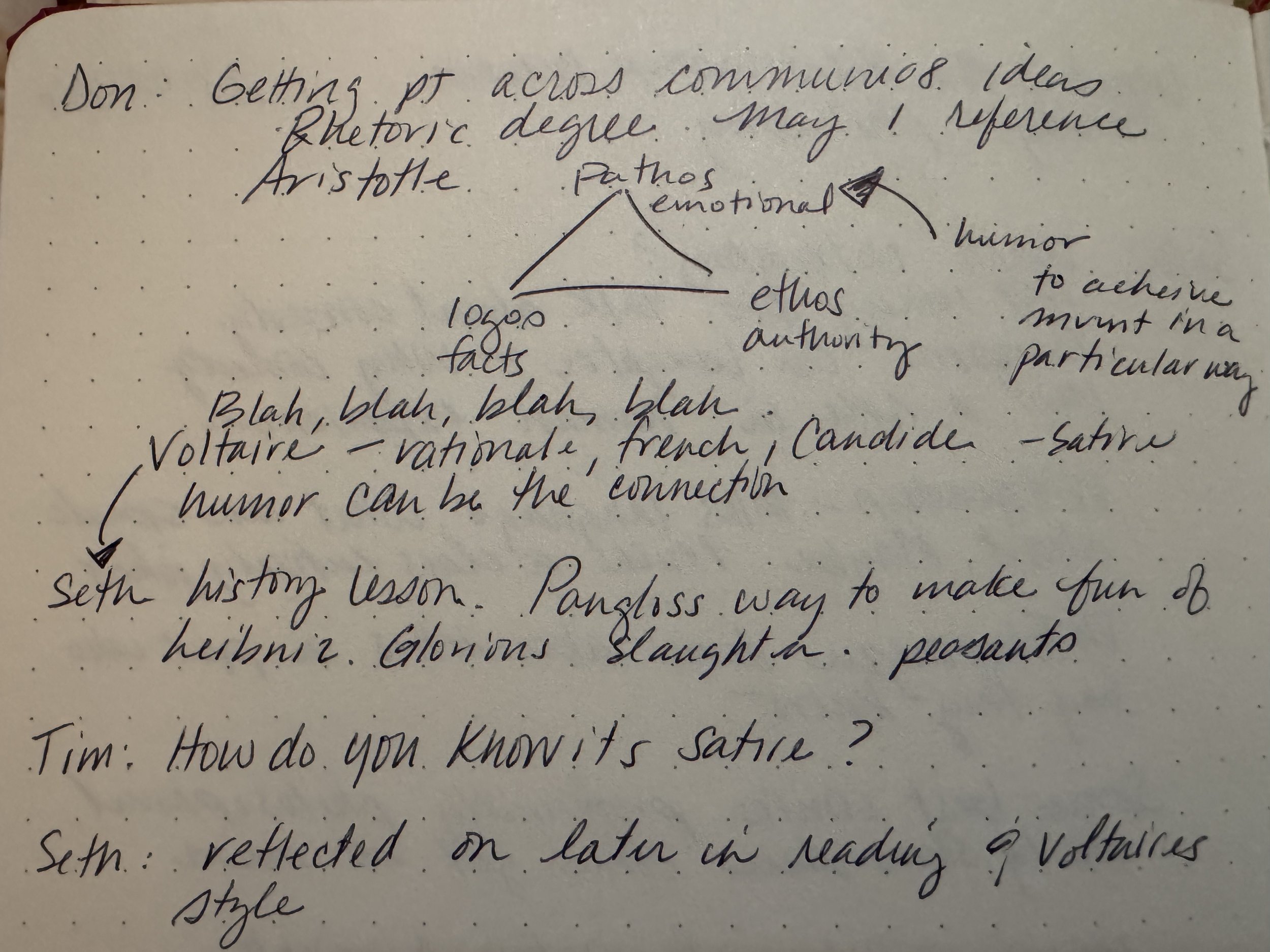
Notes on Don’s rhetoric.
Seth really liked the Voltaire example and told the group a little bit about him. Voltaire was one of the rationalists. French. Wrote Candide, a satire. There's a character named Pangloss a figure written to make fun of Leibniz—who goes on and on about the glorious slaughter of peasants.
Tim wanted to know how Seth knew it was satire. Seth explained it's reflected in the reading, and that this was part of Voltaire's style. Since I know Tim likes a little extra research here’s a fairly recent EBSCO article on Candide.
More on Voltaire. This is one of our earliest videos. The tech is old and we’re amateurs, but the teaching is solid.
Is there some insight you can't get to without humor? And if so, why does that work? What does comedy do?
The Jester's Job
Jan brought up how powerful and important jesters were. The jester had a way of getting information to the ruler that would be undesirable (I think she meant the ruler didn't want to hear it, but I'm not sure - let me know if I’m wrong Jan). But because the jester used comedy, the information could be heard.
I’m intrigued that Jan left who’s doing the hearing ambiguous. It got me thinking more. Is there a way that humor is one of the gatekeepers of knowledge, like the librarians of two weeks ago? What is the relationship between humor, the taboo, and power? It’s too bad we don’t use the word “wit” to describe people anymore. Talking about comedians as great wits feels like it speaks to some of what we were talking about and feels like its our contemporary version of a jester. We didn’t actually talk that much about Comedians. Which kind of surprised me. I was just waiting for my moment to reference Chappelle and it wasn’t ever quite right.
Chappelle Mashup
It's hard to imagine another activity that can get to so many dimensions of an idea at the same time. As a philosopher Seth is interested in the dynamics of concepts. And apart from spiritual concepts which feel very different, but share similar capacities, he doesn't know of many other things that can do what comedy does to and with ideas.
Thom had three things he wanted to say. (Everyone had three things tonight, apparently.) First, he wanted to relate teleology to George Carlin—Thom's personal favorite philosopher of the century. He shared Carlin's quote: "If you think you're part of the solution, you're part of the problem."
Big Carlin Energy.
My notes say Seth responded with a long ineloquent response. It was a tangled philosophical treatment. It went something like, “philosophy philosophy through which 50 cent word allows for the possibility of teleology is-ing which then phenomenologically blahs the blahs all the way to blah-town” If you weren’t there, I probably sound a real pain in the ass to be married to, but Seth was actually doing it on purpose, so I don’t feel bad. Seth’s point was that comedy is better at getting to insight than philosophy in some ways because it can be succinct.
Thom's second point was that someone who makes you laugh is a comic, and someone who makes you think and then laugh is a humorist. Interesting division. The group didn't really take the bait, but it would have been an interesting path to go down.
Thom saw how comedy can deprogram the audience from a social condition. He loved what Jan brought up about the jester. He told us a lot that he really loved it. The jester is there to say what the king wouldn't say, or to demonstrate idiocy.
Bob brought up that we need humor, especially humor that makes us think.
Why do we need humor?
Bob felt it's because the world can be genuinely depressing. We need to make it okay. Comedy broadcasts the humor we need to handle and deal with all the death and destruction and chaos in the world.
Then he said, "You know me, I'm going to disagree." He was thinking about Thom’s reference to Carlin and it triggered thoughts about schools and how the education system promotes the idea that there is one right answer. Bob is a crusader against the singular. This, I feel goes hand in hand with his deep love of complexity. He told us, if you think you have the solution, that’s the problem. Not in solutions, instead in the idea that there's only one solution.
Bob shared another Substack read, he introduced it as a piece about "Ayn Rand’s writing on the Holocaust" and a tenuous connection to Zionism.
This is a little like last week when we had to unpack Hinkley’s muse (who’s that guy?). So this week we had to figure out that Ayn Rand did not, in fact, write about the Holocaust, and that Hannah Arendt is who Bob was trying to remember. This made much more sense to the group. Dare I say, we found the idea of Ayn Rand’s work on the Holocaust…humorous? Ba-boom ching. I’ll be here till the end of the article guys.
Bob's point was that it's important to embrace the deeper, darker humor. “Otherwise we just kill ourselves.”
Gallows humor and the Holocaust. Yep, that's what we’re talking about.
Neuroscience Nerds in the House
Tim didn't download all the fascinating papers about function magnetic resonance imaging of the brain before showing up tonight, but he was able to see that there's some evidence that humor exercises portions of our brain that help us relax. There's neurological evidence for this.
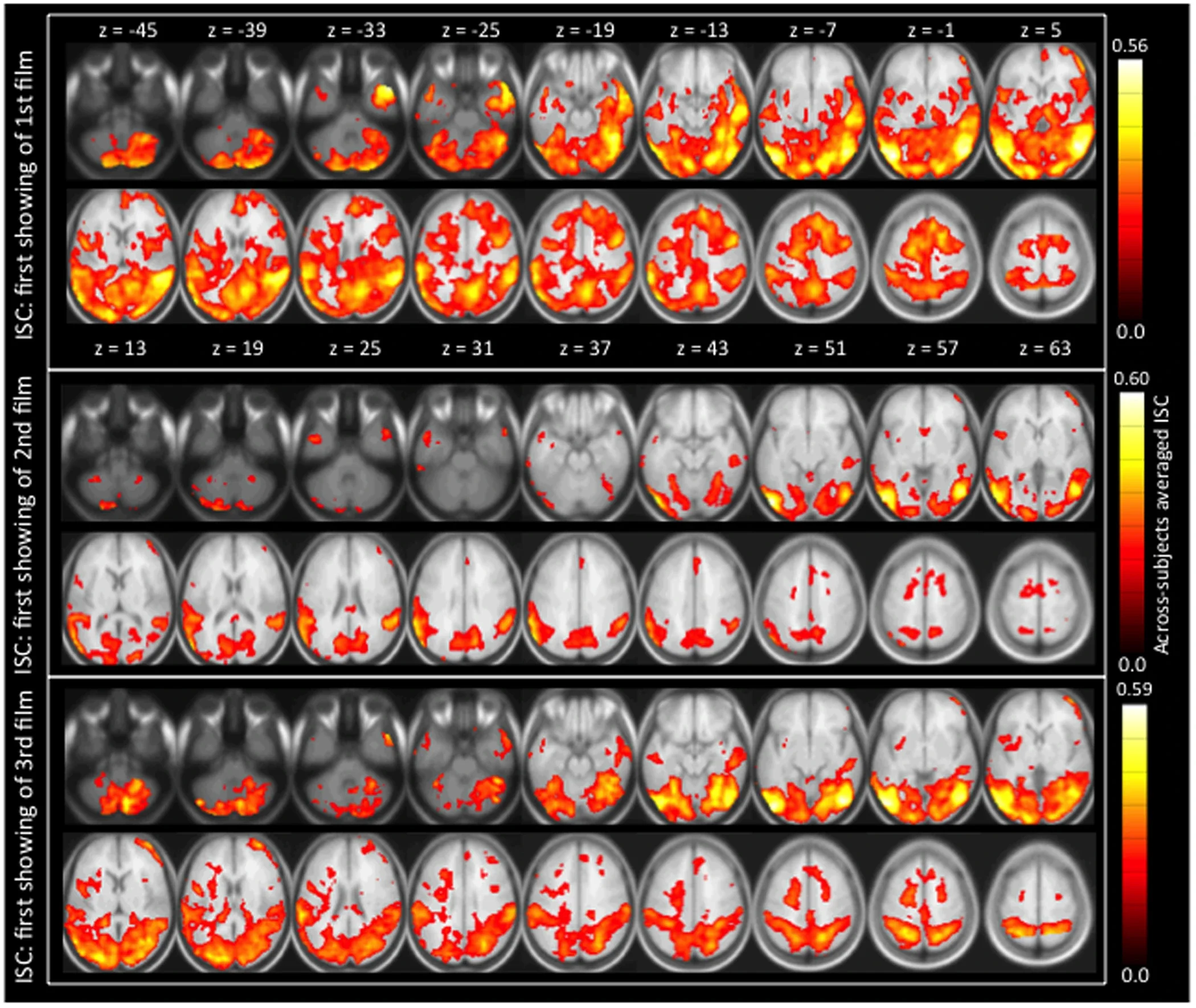
This is a bunch of brains. This is a bunch of brains on humor.
Then we got to hear from Jerry. (Welcome, Jerry! First time. Thank you, Fondren, for sending such a thinker our way.)
Jerry wanted to tie back to earlier in the conversation—how we process the news through humor. He's really fascinated with the brain. He likes to read books about how our mind works, and the way we deal with fear came to mind for him. The way our minds process fear and excitement are very similar. When we're in fight-or-flight mode, we don't have any processing capacity. But humor feels like it's safe. Like humor can give us the capacity—or it's a pathway back to processing what could be so overwhelming it puts us into fight-or-flight.
Seth asked, "Why do you think humor feels safe?"
Jerry thought it's because we can feel relief. We can relax with humor. Which resonated (ha!) with what Tim had brought up earlier. Tim really liked what Jerry was pointing out and was inspired to look into it some more.
Seth gave a phenomenological treatment of humor: that it releases tension from places we are aware of disjunction.
I was thinking that maybe part of how humor works is that we know we're in this constant state of chaos in the world, but our brains don't like to think of the world that way. We like to think about being in control, having categories and labels, being able to project what the future might be—because that's what feels good for us. But it's not the case. And when we laugh at a joke, we recognize that we're in the midst of the chaotic. For just a brief moment, we can be parallel or in sync with the chaos. We can ride it.
It reminded me of Meg from A Wrinkle in Time—where for just a moment she understands what's going on in the story she's a part of. But it never makes sense to her again after that. She only has the memory that she did get it, for a brief moment. And it's enough to keep her going.
The Mechanics of Getting It (And Ruining It By Analyzing)
Tim pointed out one of the big troubles with finding the connection or similarities between philosophy and comedy is that they are both so big they defy definition.
He got into the way our brains like to model, and how we use models to think. How distinctly the human mind thinks. Comedy structure sets up a context, and then the punchline shifts the context dramatically. The humor comes from shifting. Surprise is what makes it funny. But it can also get you thinking.
Seth brought up Cohen's essay, "Jokes"—an essay that points out you ruin jokes by analyzing them. The essay also brings up the idea that jokes are funny because you get it. But what's "getting it"? According to Cohen seeing something in a new way and being able to share the understanding of it.
Part of why jokes are less funny over time has to do with surprise, context, and community. Our minds and what's happening in culture are always shifting. This is part of why sometimes jokes aren't as funny later, or if you've heard them before.
Don shared his fanboyness of Mark Twain and told us about how even then, Twain was complaining about stale old jokes from the 1870s. Humor has to develop within a context. There was a lot of discussion about the timing of humor and how long it lasts.
Tim reminded us that we do know exactly how long it takes before something can become funny, due to the illustrious research of Matt Stone and Trey Parker: it is exactly 22.3 years.
Jared Fogel has Aides Clip.
Don chimed in: "Oh yeah, comedy equals tragedy plus time." This came from a Woody Allen movie starring Alan Alda, Crimes and Misdemeanors.
Alan Alda’s character waxing on about his own genius in Crimes and Misdemeanors
Tim also lifted up that sometimes comedic genius transcends time. He used the example of Twain. He said that when he teaches statistics classes, he likes to open with Twain's quote:
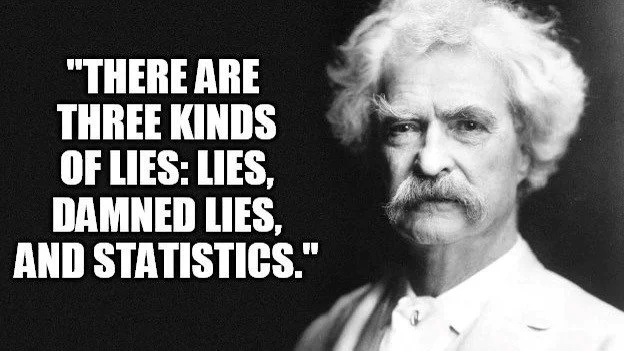
Twain.
Dale pointed out Seth's missed opportunity. He really wished the talk had been kicked off with "Three philosophers walk into a bar…" The group got a kick out of this and agreed that Seth had missed an opportunity.
Dale saw the way humor could ease tension. When two people disagree and know they do, humor can be used as a tool to at least continue the conversation or presentation.
When Laughter Brings You Back
Jan shared her experience as a receptionist at CBH back in the '90s—being in charge of scheduling, managing a room filled with a wide variety of people and issues, as well as answering the suicide hotline. Every day, the oldest counselor who worked there would come to her desk at five o’clock and announce: "Well, that's one more day closer to our death."
Jan said it made her smile even on the worst days. The punchline reframed the context everyday.
Then she shared a story about a friend who lost her grown child and how intense the grieving is. Her friend simply cannot function right now. No, next steps, no thinking about anything.
I know the grief she’s talking about. When my brother died, I saw my mom struggle to move.
Jan took her friend out shopping recently and was able to crack some weird jokes. She can't even remember what they were. But what she could remember was the impact they had on her friend. She saw her friend's eyes refocus. She saw her friend come back to the world for a few moments. Maybe there’s something of the unveiling characteristic in comedy. I think of the greek word for truth aletheia. It also translates to an unveiling.
Jan was pointing to a mysterious centering effect humor has on our consciousness.
What Babies Know (And What Primates Share)
Kara jumped in. (Welcome, Kara!) She was struck by Bob talking about how depressing the world can be, and she pointed out that babies laugh right away. It's just instinctual. There's something physiological. Humor and physical laughter are something fundamental for us as humans.
Bob quipped they're not laughing with us, they're laughing at us.
Whatever the reasons, they know how to do it.
Tim brought up that one of his interests is the intelligence of humans and other primates, and that primates also share laughter. It has a deep association with the social part of a group. It has to do with being in the group. This is so deep in us socially we could have set up an experiment at the beginning of the night. If half the people had been laughing before the other half showed up—it's quite likely that those who weren't laughing would begin laughing. This idea that laughter is contagious has to do with desire for social belonging and the babies laughing right away points to this idea too.
Jerry mentioned that feeling you get when a couple of people are laughing and will only say, you wouldn't get it, it's an inside joke. It’s a terrible feeling of being left out.
Jo chimed in with how we haven't even touched on female nervous laughter or contemptuous laughter. And then the group started thinking of all kinds of additional humor and laughter we didn't even get a chance to touch on.
Drama, Slow-Motion Horror, and the Toaster of Absurdity
Max liked the idea that you could ride the chaos. Drama is different from comedy. It requires a different kind of emotional connection than comedy does. He brought up a scene from Atlanta—about returning a toaster oven. An old white lady in an electric wheelchair accuses the character of stealing the toaster. This deteriorates into a horror chase where she's pursuing the character with a knife. But she's in an electric wheelchair, which is going really slowly. But it's got all the trappings of a Jason chase scene—just in slow motion.
Darius Makes a Return
The comedy helps the audience process the absurdity, helps us ride the chaos. Comedic extremes can reveal the chaos of our norms.
I missed what Don had to say about the Joker because I had to go to the bathroom and went to refill my drink. But apparently I missed a really great line, because I heard the group laughing. Somebody said, "Oh, and Gad's not here to write it down," to which I playfully shot back, "Write it down for me!" I was delighted to see Tim snag my notebook. The group was laughing about …fart jokes.
Still Cooking
Comedy may not be one thing, what are the different pieces?
Is there some insight you can't get to without humor?
Why does humor feel safe? We got partway there—relief, relaxation, the neurological stuff—but there's something more mysterious happening.
The event horizon Seth mentioned. What can't be joked about? And why? And when does that shift?
Thom's distinction between comics and humorists—the group didn't bite, but it's interesting. Is there a meaningful difference between making someone laugh and making someone think and then laugh?
Female nervous laughter. Contemptuous laughter. Evil laughter. Inside jokes and exclusion. How laughter connects us and also marks boundaries. We touched on all of these, but didn’t do much with them (yet!)
The difference between delight versus humor.
Why/how is comedy doing so much philosophical work?
What We Know We Don't Know
Comedy does something to our consciousness that philosophy can't always do alone. It shifts context. It releases tension. It brings people back from grief, even if just for a moment. It helps us process chaos by letting us ride it instead of being crushed by it.
Maybe some insights can't be reached without laughter. Not because the world is funny, but because humor is a way of seeing we know less than we think. A way of recognizing the absurd. A way of feeling connected when the world feels far far away..
Thom couldn't believe we hadn't told any jokes, so he asked if we wanted to hear one to wrap up the night. I'll share it:
Did you hear about the constipated accountant? He couldn't budget, so he had to work it out with a pencil.
Pun-errific. It’s a gift that keeps on giving.
Join us next week. Super Bowl Sunday is coming up. How about some philosophy of SportsBall? I once wrote a paper about the NFL stadium as an American panopticon preventing progress toward universal healthcare. Spoiler alert: it’s working.
Shout out to the quiet ones.
