
How Many Scoundrels does it take to Count the Greek Muses?
Scoundrels Discussion — January 21, 02026
Back in early December, Don's Facebook feed was serving up bits and bobs. He proclaimed all new construction should include gargoyles, a desire to drive the coast during king tides "partly for the drama"—and tucked in there was a question: "What is a muse?"
I replied:
“A thought goblin from the little known genera of profundida syngesium. It’s a rare beast. You cannot summon it. You can only trap mundanity long enough for it to arrive. And when it does, nothing looks sacred anymore except motion itself. No one has ever seen it clearly. But entire civilizations bear its bite marks. (Can we borrow this question for Scoundrels)?”
He graciously said borrow away.
Fast forward to last night. Fifteen of us in the room. We had two more newbies—welcome, Carol and Isa! Carol’s been coming to classes but this was her first Scoundrels discussion. And shout out to our quiet ones in the pack, happy to be there listening. I'm glad we've created a space where our listeners (dare I say introverts) feel welcome.
Don's been wrestling with this question for a while. He's dealing with a creative block. And there seems to be no muse in sight. He’d really like one to wake up his creativity. So, he’s been thinking what the difference is between a muse and inspiration? Can you make up a muse? Can you imagine it into being, or does it have to be a real thing?
He's been thinking about history and myths, old adventures, ancient medieval stories. "Sing, O Muse" has been running through his mind since at least that Facebook post. He thinks about Don Quixote and Dulcinea, about traditional courtly love when poets and knights created for someone who was never going to be achievable, never attainable, channeling the unobtainable into creative ventures that were hopefully acceptable.
Inspiration can come from anywhere, but what are the expectations of or the defining features of a muse? Using the Greek muses as an example, Don pointed out how frequently muses were female. He thought maybe there was an essentially feminine aspect to muses.
So Don’s creative plight was the kickoff for our discussion.
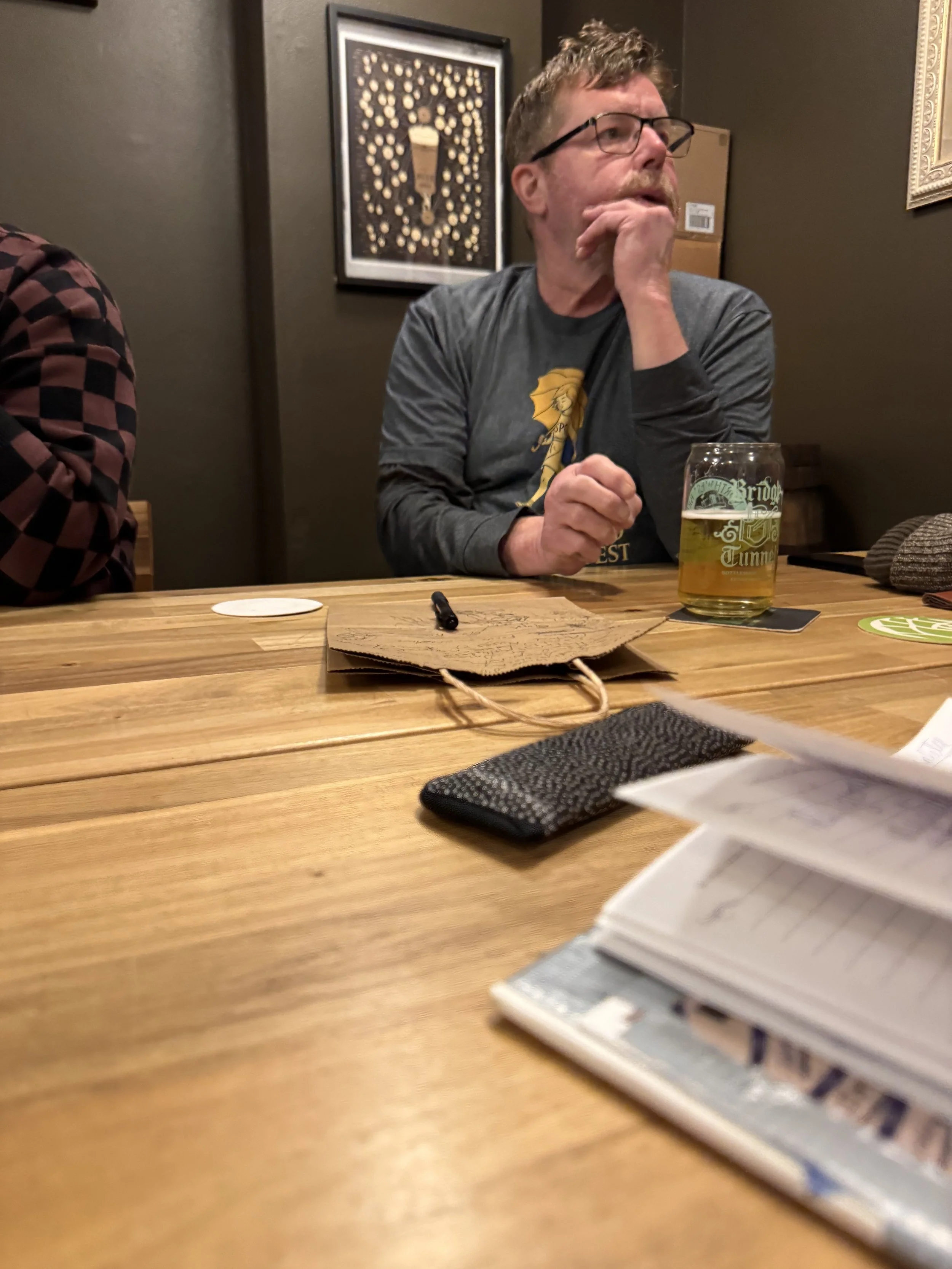
This is Don’s thinking face.
Is It Different From Inspiration? (Don Really Wants to Know)
Seth lifted up that in our modern sense we tend to use "muse" and "inspiration" synonymously. Why make the distinction?
Don's thinking is that inspiration doesn't require a muse, it can happen without a muse. But there’s something special about a muse. It is abstract; inspiration is more direct. But a muse is attempting to do something inspiring. Inspiration is more on a personal level and a muse is more sublime. The closer you get to a muse, the more it becomes inspiration. The realer the relationship, the less sublime or abstract it becomes. I really liked the idea of muses being sublime. It could have been a really interesting path to take considering the possible relationship of a muse with a sense of terror, insignificance and connection, or a spiritual experience. But that’s not the way it went. That’s popcorn for a different day.
I could feel the significance of this question for Don from across the table. Have you ever had one of those ideas you knew you wanted to untangle or figure out or get deeper with? You know you're on to something meaningful, but you also have a hard time getting further than the question? I know I have.
He kept bringing us back to how is a muse different from inspiration? A muse demands something of you. A muse is a commitment. Art is inspired by different muses, but there's a drive. Maybe it could be a god, something above or beyond, something you're trying to attain.
Seth thought this way of describing a muse as erotic. Like the Greek sense of Eros a force of chaos and a drive to procreate
Don can't give a final answer. #TheHumanCondition.
Seth mused (wink, wink) there’s some sort of drive in the seeker. There seems to be movement—imaginative energy toward a particular end. Where’s that movement come from? How does it work?
The Feminine, Objectification, and Stalking Behavior
Jane recalled seven Greek muses, each with a gift to give. She was thinking the difference is that inspiration is inside of us—we generate it. The muse works outside of us. There's something emotional, some sort of relationship with a personification that brings the spark to our inner being. This relating with a muse helps us move the inner part of our own being out.
And then she added there's also a shadow part of the muse. A muse allows us to avoid personal responsibility for the creations.
This got oohs and ahhs from the group.
Maybe we have output anxiety, she continued. We worry about holding the responsibility. Looking at the courtly love example from ages ago, having a muse allowed the creators to be really raunchy.
Seth stretched and played with her idea like taffy on a machine built of concepts and big philosophy words. A muse is perhaps the objectification of inspiration.
He also pointed out that the word "muse" and "amuse" don't come from the same place. Don was aware of this, “amuse” is from old French. And some etymologists speculate that “muse” has to do with sniffing the air or putting your nose up in the air.
Jan then prefaced her thinking with "I'm weird. I'm looking at this from a feminist perspective." We didn’t think that was weird, just awesome.
She was thinking that the idea of muses being essentially feminine only seems that way because men were the only ones allowed to write. Women weren’t allowed to. She sees male stalking behavior in this idea of the feminine muse. This is men trying to own a part or the whole of a woman, or the feminine itself.
The idea of a muse is so old it's pre-literate. Seth considered the idea that objectifying inspiration and the idea of the feminine muse might be related.
Jan said yeah, it's easy to blame women.
Tim said I can't think of any muse ever that's been a scapegoat for somebody's creativity.
Jane referred to the biblical origin of a scapegoat it released into the wilderness to remove the contamination of the sins of the community. To absolve it from responsibility. We didn’t then talk about the idea that a muse might be a ritual cleansing force. That would have been cool though, right? Instead Jane warned us what she was about to say had a gender bias she didn’t really believe. And then dropped the epic line: “Maybe men can't have a creative thought unless it's inspired by a female.”
Bob: "Make sure you write that down, Gad."
Already on it, Bob.
Somewhere in here Jodie Foster as a muse was mentioned. We're an intergenerational group with a wide variety of knowledge bases, so we had to take a moment to look up Hinckley's name, explain who Hinckley was, and get everybody on the same page. The connection here was between a muse and obsession, scapegoats, and maybe a little bit of the feminine connection, but not explicitly.
Jane got to thinking about balance. Maybe muses help us balance our energies. She also connected the idea of balancing feminine and masculine energies wondering whether Kelsey is Taylor Swift's muse, or is Taylor Swift Kelsey's muse? Either way, they're all making money.
I had to ask who Kelsey was. My Swiftie trivia extended to Travis’ first name only. I thought Jane was talking about some lady friend or lady fight that wasn’t on my radar. Nope. I just never bothered with learning his last name. I do like the idea of an athletic expression of a muse.
Then later, Jane asked the group how they would react to receiving an anonymous note, inside it read "you are my muse"?
Tim would be flattered.
Me and Abby would be creeped out. I didn’t take a roll call for votes. I got the vibe there was a gender divide there.
The gentle muse builds careers out of noses
Jim wanted to lift up that this idea of a muse didn't have to be so extreme. Maybe there's a spectrum that muses are part of. On one end there's stalking, and on the other end there's Kramer from Seinfeld being painted.
He shared with us that the tables at Fort George have a particular look to them, and the artist who made them was inspired by his friend's nose. This artist puts Eddie's nose on all of his work. It's just a nose. It's kind of cute. The relationship with a muse can be more gentle.
Seth asked, is it still catalytic?
Jim thought, no, not in a mythical sense, but it did start an entire career.
Tonia brought up a comedy she’s been watching. She noticed that comedy makes us laugh by pointing out unexpected nuances. She's been watching this British comedy that has a really gorgeous red-headed French artist character, and the character's muse is a stiff British man with (the room was delighted with her diplomatic turn of phrase) "all the characteristics of aging."
Tonia explained that this female bombshell was totally objectifying her stodgy muse. In the show it's borderline obsessive. It's too intense. Is the humor is in its unexpected turn of a stodgy, old, male as muse? Or as the woman objectifying the male in such a manner? Or something else? We’ll be digging in to the relationship between comedy and philosophy next week.
Seth wondered whether there's a way that creative objectification could drive one forward. When do muses appear? Is it only when we're in a rut?
Don wrestled with the idea that the personification of the inspiration is the muse. They don't have to interact with the creator. The creator can be obsessed.
Seth asked, could you have an oblivious muse?
Don said yes.
Petrarch's muse came to Seth’s mind, but not her name. A few of us in the group looked it up to find Laura. But that was the end of that line of thinking.
Let’s get Physical. Physical.
Thom's been thinking through Dawkins lately. He recently read The Selfish Gene and he's been thinking about Susan Blackmore's ideas about memes. So he wanted to think about muses in a genetic sense—how brains work, how we work through things.
He was thinking about the idea of a gene and a virus and that a meme was named after the greek muse Mneme. There was an artistic proliferation about fifty thousand years ago. Thom thought a muse is not outside or external but from within. Maybe the vagus nerve, he guessed.
Seth asked, do you think it's purely physical? Like a condition within how consciousness is operating?
Yeah, maybe like the temporal lobes said Thom
Seth marinated on the idea of a muse as physical. If we have this idea that a gene is information, like a piece of a blueprint to order structures, is a muse only a result of the physical?
Jan was up for a little ride on the brain train. She told us about trying to read The Origin of Consciousness in the Breakdown of the Bicameral Mind back in the day. She recalled the book describing thoughts as something that seemed like commands from external gods. Maybe a muse was just people trying to understand where thoughts come from. Maybe muses never existed at all. It was just a word we used to think about where thinking comes from. Maybe that cool little show with the holodeck was basically a modern version of the same type of idea. A place to relate to thinking and imagination.
I mentioned the episode where they get stuck in the holodeck. And for my fellow trek nerds, not only was there an episode where this happens, it was, in fact, the very first TNG episode that the holodeck appeared in. Season 1, Episode 12 “The Big Goodbye.” I’d add a video, but it’s on Paramount and a paywall link would be a bummer. Anywhoodle, back to the conversation at hand.
Seth talked about existing as an account of something. In the same way that narratives exist, they exist as an accounting for, rather than in a material sense.
Tonia was into the biochemical idea Thom brought up and connected this to Don's creative block. She was considering interaction. Maybe it could be that an interaction with person or an object could trigger a dopamine hit that then kickstarts a generative and regenerative cycle. It doesn't require interaction with the muse because it's all self-creative to begin with. But the magic is that the generative becomes the regenerative.
Seth asked the group about the object of imaginative capacity—not the object itself.The process of objectifying. Can that be cultivated?
Tonia thinks it can be. It's kind of cool. Kind of like alchemy of the soul said Seth.
This alchemy idea springboarded Seth into the territory of the Guru and another handful of Sanskrit interpretations. He talked about definitions of darshana, shishya, the cultivation of relationships, and how the word guru is made of two different definitions and roots that all work in harmony resulting in our understanding of the word. Not in the "oh my God I'm a god" way. The role of a guru as cultivating self-realization—sort of like the ultimate creativity.
Seth can read Sanskrit, by the way. And he's being modest, so he didn't mention that the guru as teacher and teaching the unteachable was the topic of his dissertation work. But I'll brag him up a little bit myself. It also means, he said A LOT more about all that stuff.
Hannah the Bird Sculptor
Carol—welcome to Scoundrels, Carol! Brought in a newspaper article with an artist, Joseph Havel, who she considers one of her muses. The artist's muse is a bird named Hannah. The bird chews up balsa wood and cardboard. She rips stuff up and then rearranges it, he then casts her creations in bronze or coats them in resin. Havel's sculptures are a partnership with his bird friend, Hannah.
Carol didn't want to focus on money, but these sculptures sell for $35,000-$120,000
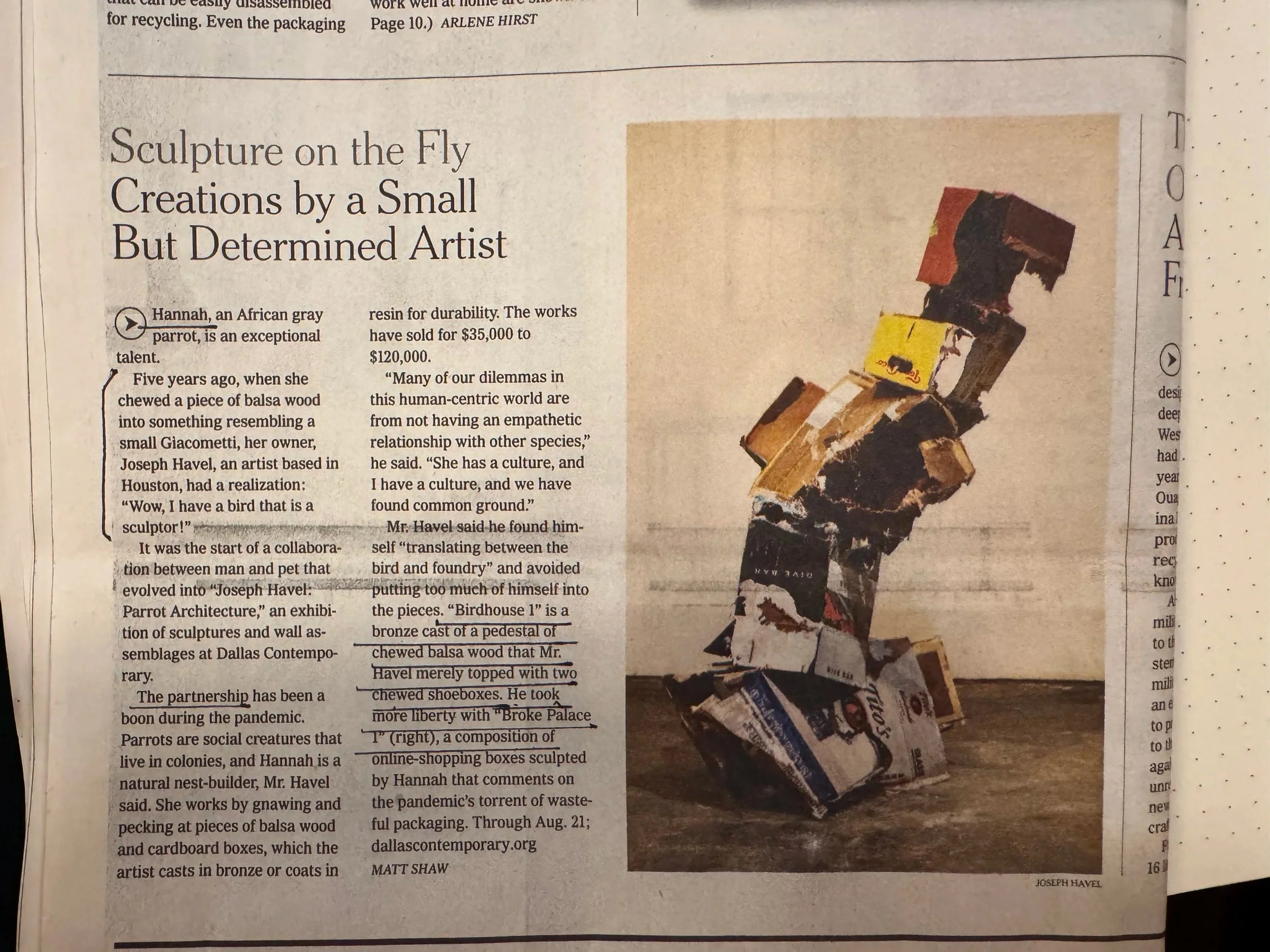
The article Carol shared with us.
Seth thought this seemed to point to a reciprocal quality in a muse. Some cultures embrace that idea more than others.
Don wanted to know how it could be reciprocal if it's possible for one of the parties not to know?
Seth acknowledged the critique and offered the word emergent as closer to what he was trying to get at. Words are hard. Especially, when we’re playing with philosophy.
Jane asked who's the muse, the bird or Havel? And she thanked Carol for bringing up our furry friends.
Birds immediately made Bob think of cats. He took us on a fun tangent down different cats who have been muses in the past—like Bastet, the Egyptian god, or the Cheshire Cat. Bob had thought that perhaps Dvorak’s Rusalka might have been inspired by cats, but it turned out that wasn't the case.
Can AI Be a Muse? (Bruce Wasn't Here to Ask)
Jane thought it was too bad that Bruce wasn't there. She imagined Bruce might ask if AI is our current muse.
She thinks maybe muses are what inspire you to personally step out and see where you fit into the mainstream of humanity. It's what helps us think about where we fit in. We're constantly seeking: why am I here? What is my purpose? Who do I serve?
She thinks it's possible for AI to become a muse.
Seth felt skeptical. If AI became a muse, it might be the end of musing.
Jim immediately thought of Her, the movie.
And Tim, who works with AI, was very concerned about the idea of AI being a muse. He thought it might be impossible since AI is only ever a reflection of what already existed. And even that is rapidly degrading because of all the AI slop that now is the training ground for AI.
Jane argued that perhaps the concept of a muse is exactly that—a reflection of what's already there.
What We Know We Don't Know
Tim offered up, “Museness is in the eye of the beholder”
Seth agreed and wondered, “What is it about a muse that sparks that creative generation? What exactly?”
Don still can't give us a final answer. Of course not. Maybe the question itself is the muse. Maybe Don's wrestling is the work. Maybe Don will conjure up a muse with a fermented beverage from Bridge and Tunnel.
There was no consensus. A muse might be internal or external or both. It might be physical or metaphorical or accounting-for-where-thoughts-come-from. It might have a feminine essence or it might seem feminine because we have more records of men's expression and experience. It might help us avoid responsibility, or it might cultivate self-realization. It might be stalking behavior, or it might be Eddie's nose on a table.
Maybe we're all Hannah the bird, chewing up paper and rearranging it into something new.
Maybe the muse is just what we call it when motion becomes sacred.
Shout out to the quiet ones. You're here and you rock.
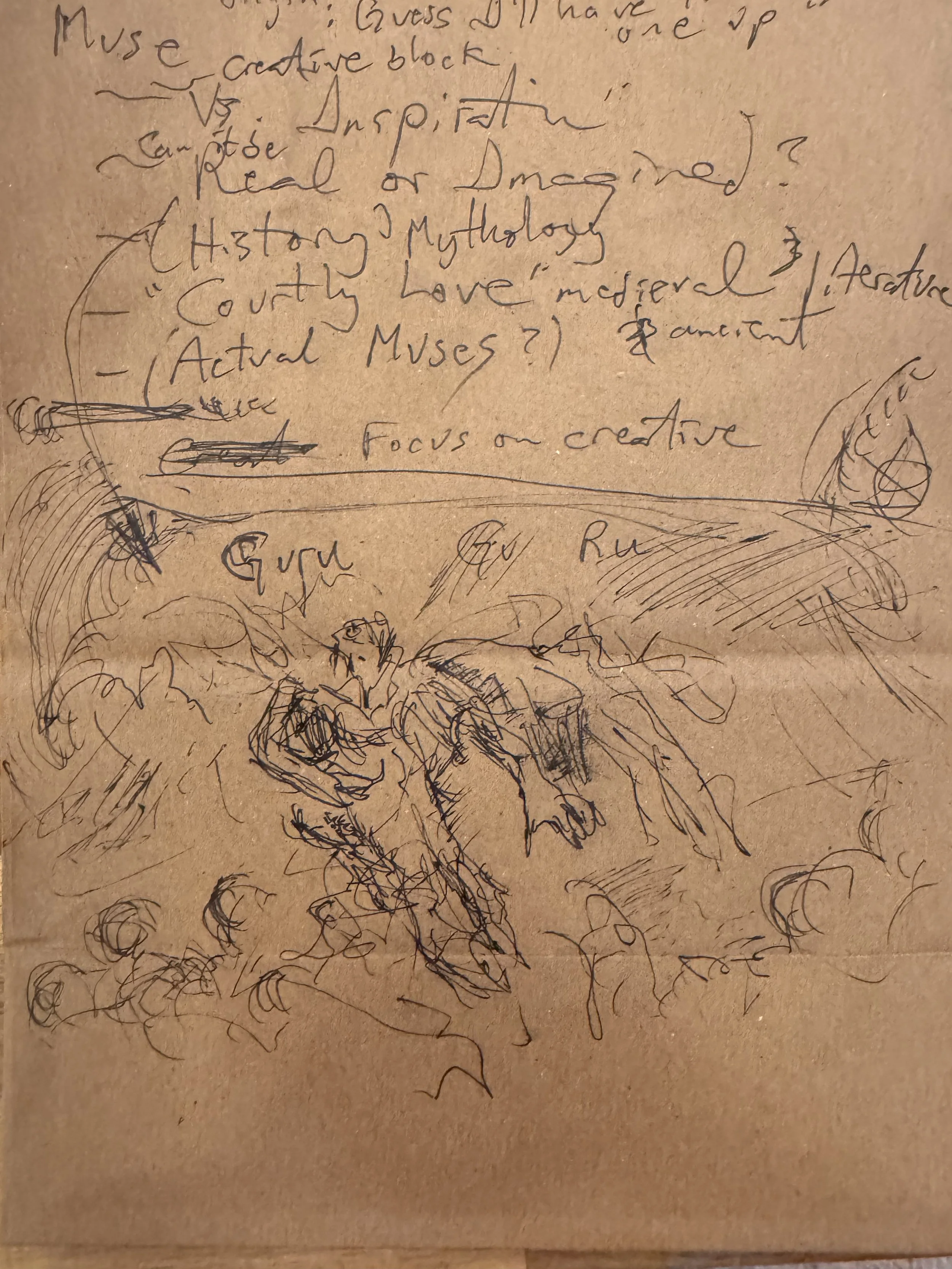
Don’s notes and doodle on brown paper bag.
