
Oct 26, 2026 · @Gad
19 Scoundrels on Wednesday, 3 on Saturday (not counting me and Seth, you know the drill)
Wednesday was packed. Welcome to our first-timers: Eric, Annie, Sam, Lindsay, Marja-Lusa, and Lila. And here's a first for the history books: Thom came to both conversations, which makes him our first-ever double-dipping Scoundrel. Thom, we see you. This is the Catalyst that Thom helped build!
This week I'm trying something a little different. These two conversations went in such different directions that I'm going to give you each one on its own, then meet you in the middle. Shorter, too. Let me know how you like the length (snicker, snicker).
Seth Lit the Incense
Seth broke the question into a few areas. What exactly is a ritual? When does a series of actions become one? Ritual seems to do something: we take actions, make motions, and then the world seems different. How does that work? Is there an ethic to ritual, since anything with that kind of power seems to need one? Can there be ritual without another person? And how real are rituals? If they're symbolic, they seem less real in one sense, but more real in another, by virtue of how they work.
On Saturday he added a word he was surprised he'd left out on Wednesday: hierophany. It comes from the Greek for sacred and to show: the sacred showing itself.
WEDNESDAY: Who Belongs?
Ritual, Routine, Tradition, Pattern
Mary Jo started us off: a ritual needs to be repeatable, and it needs to have meaning.
Annie, one of our first-timers, engages in spiritual rituals daily and comes from a Catholic background, where the Eucharist raises exactly Seth's question about how real a symbol is. She’s not eating meat…and yet what exactly happens when a group symbolically eats and drinks a body and blood? Sam came at it from somewhere else entirely. She sees rituals as a kind of technology, mechanisms for weaving from one state into another, and not specific to human consciousness. Thom asked if she meant genetics. Not exactly, she said. It's biological, but bigger, so much of existence is cyclical. Ritual is everywhere, all the time, and has little to do with intent.
Don was thinking about ritual versus pattern, like a morning routine where you go through steps one through four. For the record, the definitive example of a morning ritual set to music is Snoop Dogg's "Lodi Dodi":
wake up around ten o'clock in the mornin'
stretch up, a mornin' yawn and
throw some soap on face
put hands upon a cup
Talk to the mirror
Get undressed
Use Oil of Olay
file fingernails
take a bubble bath
(Full disclosure: I failed my first philosophy class because I went to a Snoop Dogg concert instead of writing my midterm. Look at me now. Also, why does Snoop put lotion on before the bubble bath?)
For Don, a ritual is a pattern that lasts and preserves knowledge. Think of wedding ceremonies. There's a reason things happen in the order they do, and if you dig deep enough you can find it. A ritual can even lose its original significance and still carry meaning.
Ariane sorted rituals into kinds: ones we do alone, some passed between humans or even from animals, ones that let us stop thinking (morning routines again), collective ones like meals, and ones we watch, like theater. Seth heard a kind of spiritual adaptiveness in her list. They all seemed to be about connecting. Rituals are meaningful because we can see ourselves in them.
Annie drew a line between habits, patterns, and tradition. A tradition is a group habit, like Christmas. Seth wondered if something becomes more meaningful as it moves toward ritual. Annie thought so, which struck Seth, because it would mean ritual plays a role in how we make meaning.
Lindsay brought in the Zen practice of oryoki: three bowls and a spatula, with meaning in every part of it, including offerings to the spirits. It's both ritual and tradition. And by the way, it is not part of the ritual to announce that a ritual is happening Lindsay warned the group.
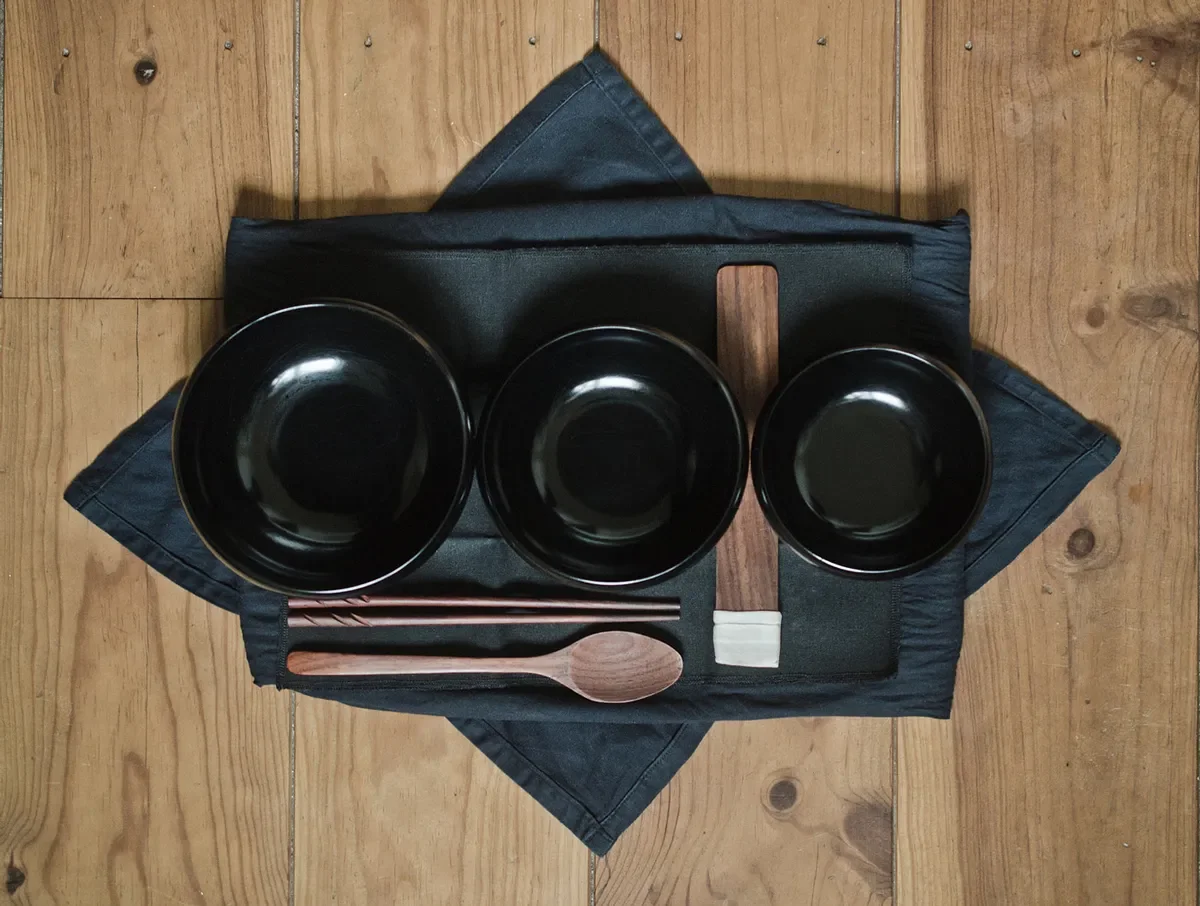
Learn more about oryoki by clicking on the picture
Bob still hadn't heard an answer he liked. He hoped for a working definition of something. Anything. Seth asked whether ritual might be many things at once. Bob's take: maybe a ritual is important because you give it importance. Ariane offered celebration. She does sport in the morning and brings a kind of celebration to it, the way you can bring intention to making tea. Annie agreed you can ritualize anything, and it doesn't have to be spiritual. And Sam mentioned the turning of the universe as ritual.
Belonging (and the Moldy Dove)
Dale brought up uniforms and authority. People find comfort in knowing what's expected. Bob had heard "authority" and wondered if hierarchy was the better word.
Then Jane told us about all the rituals she's taken part in over her life. She was a Job's Daughter, which came with a big book of rules. All the animal groups have rituals, she pointed out, the Elks, the Moose, all the clubs that used to thrive. For her it comes down to a human desire to belong and to find others who share your beliefs. She thought about everything she'd memorized over the years, and the reason underneath it all was a basic sense of belonging.
Seth asked: does meaning emerge from belonging?
Jim finally got his turn and said Jane had already said all the cool things he'd wanted to say. Mostly about belonging. We need to be seen. We need to see others. And we need to feel sane.
I liked thinking about what belonging could do in wider frames. If meaning comes from belonging, what does it mean to belong with the trees? With the wind? With a planet strolling through a cosmos? Seth thought ritual might give us a particular way of being that isn't possible without it.
Sam brought in Jung, who inspired her to travel, and his idea that most of our consciousness is mythopoetic and ancestral, with ego as only a tiny sliver. The more we explore the mythic and the ancestral, the more of our consciousness we can reach. Seth explained Tillich's idea that symbols both participate in reality and reach beyond it, and wondered if rituals harness symbols that way.
Jo brought up that tradition and ritual are also how groups communicate with each other, and that part of why gangs succeed is that so many homes lack rituals. What do rituals do that people value so much? She wants to understand. Seth thought it spoke to belonging at a primordial level.
Eric turned it around. We'd talked a lot about belonging, but what about exclusivity? Attending a Christian ritual for the first time can be daunting, and a gang even more so. There's always an in-group and an out-group. I wondered whether some of that exclusivity comes from embodiment. We have bodies with very specific edges and a very specific end, and maybe our rituals draw lines because that's the only way we know how to be in the world. Would it be different if we were sentient wind? Don offered a gentler reading: rites are meant to be inclusive. It's not that you're shut out, it's that you don't know them yet.
And then Jane shared the passing of the moldy dove. It was meant to represent the Job's Daughters, and she really leaned into how silly a symbol it was. Rituals do give participants secret knowledge that isn't meant to be shared, she said, but a lot of the apparent depth of secrets might come from adolescence and a belief in mysteriousness. Ariane saw the secret differently: it's an experience, a fullness. Ceremony suspends time. We put poetry in the tea. And Thom brought it back to food. If people love the dish, it's even more important to keep the recipe secret.
Throughout the evening, hippie Rick kept asking his favorite question. How are we going to survive? How do we save us? And, when we'd gotten deep into rites and secrets: but what do you do with it? Seth's response: rituals are a way to expand our sense of understanding.
And then about half the group stayed. People hung around chatting long after we wrapped, and a few new people even joined in.
Hot Take
〰️
Hot Take 〰️
Annie’s hot take:
The discussion of Ritual and what it even means was fascinating both in what it said about ritual as well as people’s approach to being in discussion. Having discussions in our current era is very difficult and the more that we practice holding space for conversation about possibly opposing view points the better. Often times the assumption of disagreement is how conversations start and it’s only through a desire to understand that we can learn to see another’s perspective.
As an individual who engages daily in ritual and holds the practice of ritual in high regard for me it was vital to keep my personal feelings separate from the conversation. I think holding that separation is what helps one remain curious about the other view points. One of my favorite things about philosophy is that I view it as a thought experiment and as a way to tumble ideas about and learn something new.
Hot Take
〰️
Hot Take 〰️
Meanwhile, Saturday Morning
Nineteen people on a Wednesday night spent a lot of their energy on who's in, who's out, and what holds a group together. Three people on a Saturday morning, coffee in hand, considered what ritual lets us notice that we'd otherwise miss.
SATURDAY: What Are We Paying Attention To?
When Routine Becomes Ritual
Ethan thought maybe ritual is a well-trodden path. Shared rituals create and fill the different spaces we move between, and they change what we have access to. At church it's totally normal to chat with your boss's boss. Walk into that same person's office on Monday and it's a different story.
Robyn pointed out that Ethan has a lot of solo rituals. Ethan asked if she meant his conversations with himself. (Last week's Scoundrels, still echoing.) Seth shared his study ritual: his incense, a very specific way he likes to sit. Part of it is practical, but it's more than that. It brings him into a different space, and he studies differently there.
Robyn asked: what's the difference between routine and ritual? Ethan offered reverence. Seth thought routine might be external. You can do the dishes without putting any of yourself into it. And sometimes a routine does become a ritual, but once it's a ritual, you attend to every part of it. Ethan noticed that means we don't always know our rituals are rituals. Plenty of people retire, hate it, and only then realize their work had been an important ritual in their lives.
Seth told us about working closing shifts at a pool. Once all the duties were done, he'd do one last round, looking everything over, then turn off the lights and do one more round with only the pool lights on. He'd already checked. It wasn't necessary. He just came to love it, and it felt like a ritual. Thom asked if that's really more than routine. Seth thought so, because it emerged from the rhythm of the work. Ethan offered a line from the movie The Guardian: the only difference between you and the person you rescue is the attitude you had when you entered the water. And Seth said that when Ethan first described ritual as a well-worn path, he'd focused on the worn. Now he was thinking about the path.
Thom saw everyday interactions with neighbors as rituals. Seth said rituals connect us deeply to one another, which is one of the great human struggles: how do we find our way to each other? Ritual is one way, and it's different from language. Ethan added that rituals establish and share culture, which is why landing in a new culture is so hard. You don't know the expectations, you don't know what fulfillment looks like, and it's easy to be taken the wrong way.
Ethan works in tech, where there's a lot of talk about AI alignment, and he thought you could talk about humans the same way. Imagine ten thousand people in Astoria with no shared culture, no shared alignment at all. It would be really, really hard to live together. Thom asked if that made rituals the rules of engagement. Ethan put it more softly: conventions, not rules. He can find the food he wants at Fred Meyer because he lives here and not in Mexico, where the ingredients, the culture, and the food are all different.
A World That's Always There
Thom asked Seth to say more about hierophany. Rituals are everywhere, Seth said. Not just in one religion, and not just now. We've been performing them for tens of thousands of years. You could try to explain them away. Maybe ancient burial rituals were just a way of discovering that nitrogen-rich soil grows better plants. But it seems like more than that. The religious historian Mircea Eliade, who coined hierophany in this sense, wanted to talk about the sacred in a non-reductive way: rituals aren't really for something else. They're their own thing. And Rudolf Otto argued that humans have a religious dimension, not just in our brains but in our consciousness, and rituals give us access to it.
Seth put it this way: rituals make us aware of a world that's always there but that we don't always pay attention to. Ritual isn't just thinking. It brings reality closer. Death is a good example. It's what makes everything possible, but we don't look at it every day. We look at it when we hold rituals for it.
Science does something similar. We're made of quadrillions of atoms. Much of the DNA in and on our bodies is bacterial. There are quasars unimaginably far away, right now. All real, and all so abstract they're a little mind-blowing. Rituals seem to act on things we know are real and give us more access to them.
That reminded Ethan of Barry Lopez's Arctic Dreams, and the scale of cataloging life. Researchers study a single tussock a few feet around, picking apart every bug and every collapsed piece, coming back for decades, until a person's whole world becomes two square feet. And then they look up and realize there are millions of tussocks. Maybe we use ritual to get access to that kind of scale.
Seth brought in Hume, who drew a line between relations of ideas (truths of reason, like math, that hold no matter what) and matters of fact (what we learn from experience). Seth was paraphrasing and he put it this way, logic without experience is empty and experience without logic is blind. Maybe human experience is always trying to bring the two together, and ritual is one of the tools that helps.
Ethan wondered if we appreciate ritual less than we used to because we write things down. Writing took over a job that only ritual used to do. Seth saw a parallel in classical Indian philosophy, which puts oral tradition ahead of written. Sanskrit is considered a perfect language for how precisely it can articulate. For a long time there was no writing at all, and the most important things had to be spoken. The words had to be savored, and only then could you know what they really meant.
Funerals, Privacy, and Kon-Tiki
Seth thought ritual helps us move toward the future, together or alone, while making sense of the past and staying present. Mourning is the clearest case. When someone dies, we're broken up and looking for a way through enormous emotions. Funeral rituals don't solve the situation or the feelings, but they can bring catharsis or communion, and help us find meaning in experiences that are new, hard, or intense.
Thom brought up elephants mourning, and Seth told the story of a herd that gathered around the house of a caretaker who had died, coming from miles around. It's helped people think about how elephants communicate, how sensitive their feet are, and the fact that they seemed to hold a funeral for a human.
Robyn said funerals give us structure and permission to hold emotions we might not otherwise have room for. She told us about the 49-day mourning ritual in Buddhism. When she shared photos of it with a class, many people were surprised. It looked like her family was having a picnic at a grave. Ethan imagined a funeral that lasted decades, and what that would change about death, or about living, if you knew you'd be remembered that long. That one resonated with me, because it's exactly what Día de Muertos does. A person's true passing comes when they no longer appear on anyone's ofrenda.
Somehow we then took a deep dive into privacy. Seth explained that privacy as we know it is a modern invention, only a few hundred years old, which arose to protect something older: the Greek oikos, the household. Robyn: "I only know the yogurt." Privacy became important because it was where intimacy could happen. Ethan wondered if it rose around the same time as romantic love (they weren't far apart). Privacy protects individuality, and it's considered an achievement of the European Enlightenment. But when privacy increases, we also lose a deeper communion that happens when there's less of it.
Thom thinks ritual has to do with fear. Ethan had just written down his own question: what's the relationship between ritual and safety? And Robyn saw how rituals bring generations together.
We wrapped up with Ethan, who's been rereading Kon-Tiki. Thor Heyerdahl and his crew sailed a balsa raft across the Pacific to show that ancient people could have made the journey. They made landfall on an atoll and were eventually welcomed into a village, where everything proceeded according to the village's rituals. There was a huge party, with food and dancing. At first the villagers were hesitant, but then the older dances began to emerge, and over the long celebration the walls came down. By the following week, all six sailors had been adopted by the village. Ethan thinks you could teach a whole course on what ritual can do from those twenty pages.
2 Rooms + 2 Groups = One Question
On Wednesday we scratched the surface of secrets: the moldy dove, rites you don't know yet, the recipe you keep to yourself. Saturday we dug into the role of privacy: the household, intimacy, the communion we lose when we close the door. Related ideas with really different paths to them. There’s an interesting set of relationships there. Rituals, Secrets, & Privacy: How much more connected could we be? Sounds like a good Wit and Wisdom presentation. What do you guys think?
Half-Baked
When does a routine become a ritual, and can you tell from the inside?
Does meaning emerge from belonging, or does belonging emerge from meaning?
What's the relationship between ritual and safety? Between ritual and fear?
If privacy cost us some communion, what rituals might give it back?
And the one neither group got to: Nathan was thinking about the darker side of ritual, all the division and harm rituals have been used for. He didn't want to derail the conversation, even though Jim tried to call on him twice. Nathan, consider this your formal invitation. It may be a whole Scoundrels of its own.
What We Know We Don't Know
Whether silliness weakens a ritual or protects it. Jane's moldy dove is a ridiculous symbol, and the Job's Daughters held together anyway. Maybe a ritual that can laugh at itself is sturdier than one that can't.
Where routine ends and ritual begins. Doing the dishes and lighting Seth's study incense can look the same from the outside. The difference seems to have something to do with attention, but we couldn't say exactly what.
Why the unnecessary part is so often the part we love. Seth's last round at the pool wasn't needed. That might be exactly why it became a ritual.
Whether a ritual should explain itself. Nobody explains oryoki to you. A rite you don't know yet can feel like a locked door or like an invitation, and we didn't settle which, or whether it depends on who's standing outside.
How secrets and privacy shape ritual. They aren’t the same thing, but both seem able to deepen a ritual or shrink it. A shared secret can make a ritual feel sacred and bind the people inside it, like everything Jane memorized as a Job’s Daughter. It can also be what keeps everyone else out, which was Eric’s point about walking into an unfamiliar rite for the first time. Privacy cuts both ways too. It makes room for solo rituals, like Seth’s incense and Ethan’s conversations with himself. But Saturday also wondered whether the more private our lives become, the fewer rituals we share, and the less communion we have.
How we take in the scale of what's real. A single tussock can hold a researcher's whole career, and there are millions of them. Death makes everything possible, and we mostly look away. Ritual might be one of the ways we let ourselves look.
How ritual turns strangers into family. Six sailors, one village, one long party, and within a week they'd been adopted. We know ritual can do that. We don't know how.
Big Ups to the Quiet Ones
Nathan, Marja-Lusa, and Lila. Listening is a ritual too.
This week at Scoundrels: What is Genius?
Scoundrels Philosophy Club: Wednesday, October 28, 5:30pm, Bridge & Tunnel Bottle Shop.
No Saturday Scoundrels on Halloween.
Come think with us.
This program is funded in part by Oregon Humanities with support from Meyer Memorial Trust. Any views, findings, conclusions, or recommendations expressed in this publication do not necessarily reflect the views of Oregon Humanities and other sponsors.
