
Orwell, Huxley, and the Influencer Industrial Complex
Scoundrels Discussion — January 14, 02026
We were a big group again—20 of us if you count Hippy Rick’s guest performance, and I do. We had some more first-timers: Ryan and Jacob. Welcome to the messiness of the depths, folks.
We also talked about adding another time slot—same weekly question, two different times to attend. As more people join us, this might help keep our conversations intimate and deep rather than turning into a lecture hall. We'll see.
Seth read an article about Orwell and Huxley recently. In 1984, information is restricted through surveillance and Newspeak—truth dictated by the Party. In Brave New World, minds are so open their brains fall out. They're restricted differently—internally, through genetics and Soma—distracted away from meaning and incapable of considering truth. Neil Postman wrote that our world today is a mix of both, though not quite as extreme.
Seth's suspicious anytime there are only two choices. Is there a balance? Is everything on a scale? Are we restricted to eventual tragedy? Does the spectrum itself cause dysfunction? What is information for? What's the teleology of it?
These are the threads that emerged. They didn't come in this order, but looking back, this is how they organize.
Filters Used to Be Built In
Don talked about how finding information is so much easier now than 20 years ago. We used to have limits and filters. If you wanted to get an opinion out into the world, you'd send a letter to the editor. Don used to be a newspaper man, and the editor would get hundreds of letters. It was the editor's job to filter—newspapers only had so much space.
Did that make information more valuable?
Don and Tim both said yes in stereo.
Don continued, the flip side is information gets cut out because of power structures like the church or the state. But there is value in filters.
Seth asked: what's the nature of these filters?
Don said expertise. Or we could do the opposite and block all information people need, forcing them to filter where they can process.
Seth told us he used to teach professional ethics, and there's a term for this: epistemic trust. To have professions, you need people who are trained, and others invest trust because of the training. But this only works if the training is grounded in something real—that gives the trust a place to be grounded.
Don built on this academics have bachelors, masters, PhD - levels of expertise Other fields have apprenticeships, journeymen, master levels.
Tim added, we also have peer review in academics. It's its own kind of filter.
The Internet Changed Everything (And We Were Wrong About It)
Tim talked about building the internet back when it was ARPANET. Everybody working on it thought it was going to transform the world for good.
"We were wrong," he said. "Now everybody lives in bubbles, and AI is only going to make that worse."
Cue Skynet
Bob brought up two examples. First: he's been listening to podcasts about the death of Renee Good, and depending on where individuals lie on the political spectrum, two different ideas have emerged with the same data. The exact same data, but opposite conclusions. And interestingly, no in-between. People just came to opposite conclusions. Was information removed? How much information is needed?
His second example: Substack. It's an extremely monetized platform where people like Glenn Greenwald can make way more money than they ever did in traditional news. Bob used to think this was good because so much information was withheld in the old formats. But the new format creates the same problem, maybe even makes it worse—information is held behind a paywall. Bob sees this as a big problem because the information behind that paywall needs to be available to everybody.
Jacob shared that in that in his generation - young ones in the house - news reporters have been replaced with influencers. He can't think of a single friend his age who reads books or gets news from a network. This is where the idea of information and monetization first started developing in the conversation. This also seeded ideas about infotainment we touched on later.
And I gotta say, this one hit home for me. Our oldest told me he didn’t need to learn how to use a dictionary, cause books wouldn’t exist when he was grown up anyway. This argument did not pass the sniff test, but it did take my breath away for a moment.
Curate, Purge, Rinse, and Repeat
Jane's a librarian, and she said the point is to present a full panoply of options. Before the internet, there were lots of books in a library, and a librarian's job was to balance between all the different books offered. There was always a budget.
To this day she keeps lots of books around. She thinks about purging them. She does. And then she finds herself right back at Goodwill, looking at books, thinking about taking them home. Sometimes she cracks the front cover and finds her own name—she's already purged that book. She's already made that choice.
We all got a good chuckle out of Jane donating a book and then thinking about buying that same book back.
She wanted to know does is mean for information to be balanced? We can drown in information when we don't have a critical way to digest it. Today we see people doom-scrolling. Yesteryears equivalent would have been to watch someone stuck at a card catalog all day long. The only way to have a healthy balance is to honor, to listen, and to have a healthy variety.
Tim challenged her: should libraries have The Protocols of the Elders of Zion or The Turner Diaries?
Seth added or Mein Kampf?
Jane replied every librarian is a gatekeeper. When you get $150,000 from that lawyer who passed away, are you going to be a museum or a library? How are you going to spend that $150,000?
She then talked about the shift to public libraries and what a big deal it was. A definitive class shift in our country. Most books used to be held in private libraries, and to this day there's still information in private libraries that's not available to the public. There’s a great book that tells the story of this shift (within the unsolved mystery of who started the 1986 Los Angeles Public Library fire) that Jane and I both love called, The Library Book (fitting, right?).
She told us a story about working at a high school in her early days. Back then, the magazine Avant Garde (dude, I found an archive of the magazine! The first issue has boobs, it has butts, it has politic jokes about Nixon I don’t entirely understand, drawings by Muhammad Ali and more. check out the link. It’s pretty cool). This magazine was about the most risque thing you could read. She made copies, brought them to school, and spread them around—blushing, while determined to spread ideas.
I love hearing Jane’s stories about what used to be racy. I remember a while back her animated telling of the horror and shame a bra strap bold enough to peak out could bring. I’m old enough to be at the tail end of that (only sluts let their straps show). There’s something in the way she acted out the scandal and whispered the daringness of it all in her telling that brings the ideas to life when she relays them.
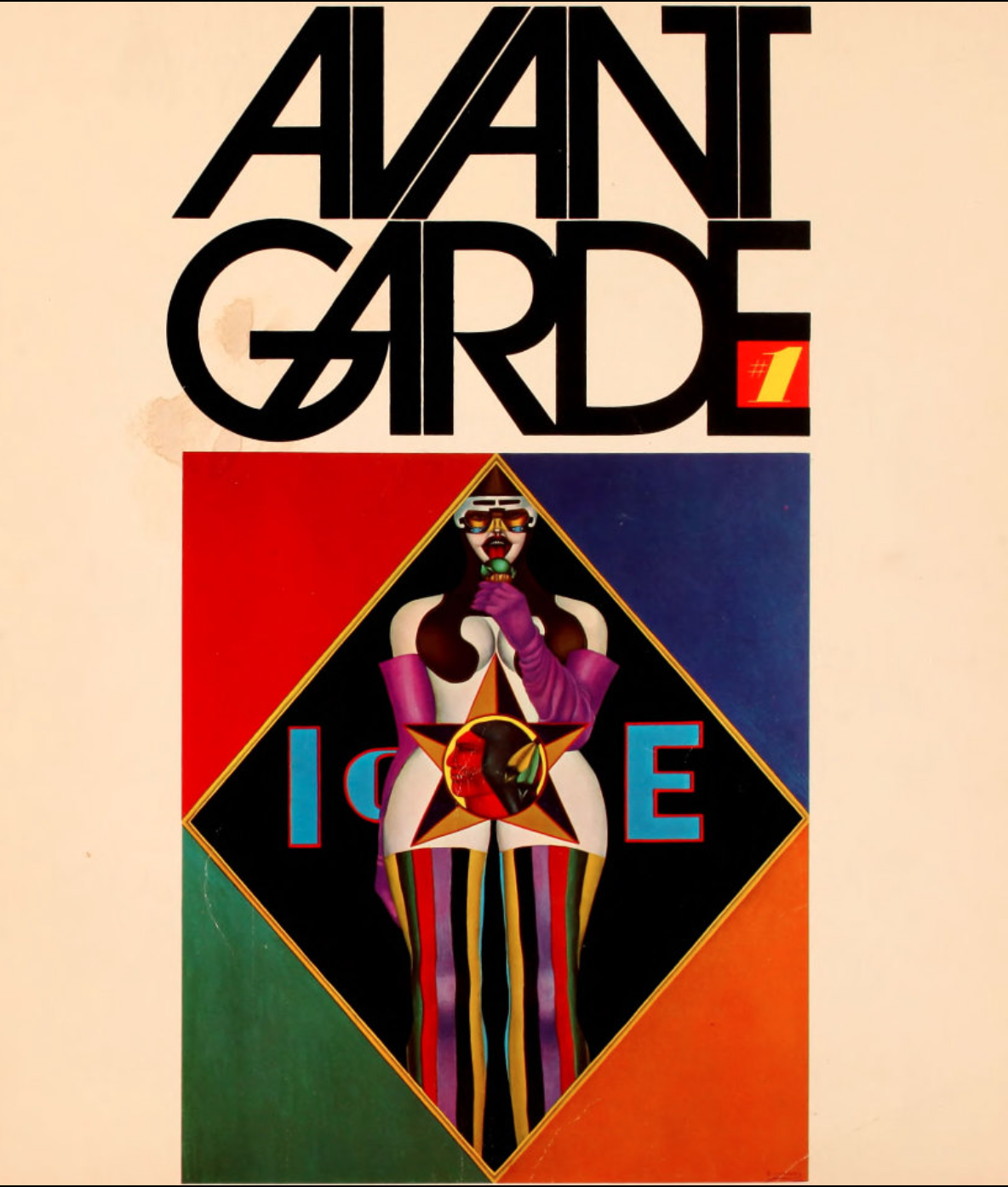
There’s a whole archive!
Seth wondered how do you consider curation? What's the broader vision? How ought we wisely hold the nature of information? How do you do that as a librarian? Have you ever noticed how comfortable Seth is with the word “ought?” I don’t know why it makes me giggle. It ought not.
Jane said it was a different time when she was curating. It used to be just the books and magazines in the room. Now we have access to every library in the state of Oregon at our fingertips. All of those books can be shared easily. And the type of library determines the curation—the sort of books in a school library versus a college library versus a public library. They all have different needs. The audience determines the curation.
There’s something really interesting about the idea of the audience determining the curation to me, since essentially they do not/cannot. An idea of the audience then, must be held to curate. Almost like curation is an attempt to assign information to what the gatekeeper would have the population…be? I don’t know. There’s something I can’t quite articulate that keeps pulling me back to this part of the conversation. I’ve written, erased, and rewritten this paragraph like five times. I know the question is more interesting to me when it’s not one about budgeting and circulation. But I am curious about the role of circulation in well curated collections.
The Erosion of Trust
Ryan, long time thinker, first time Scoundrel, thought gatekeepers were alive and well, but the problem he sees is the erosion of trust. Today it's easy to disregard the New York Times. This changes how we can communicate with each other.
There used to be three networks. There was an understanding of journalistic rules of engagement, and as a result our society was working with the same basic information. Today there are infinite places you could be getting your information from. And we look at it from a perspective of having a kind of value. Right now, that value is monetary. We treat information as valuable if it can make money.
So, what else could be used as value?
Seth pontificated a little on how information-for-money changes the way we consider both information and money. He talked about how they integrate. The words work and change over time and we begin to think of both ideas differently when we use money as the kind of value we deem information has.
In Ryan’s case, the information with monetary value is his own name. Apparently, there’s a State Farm agent out in Indiana that shares his name and wants to improve his Google standing. So, he’s been hitting Ryan up for the domain name. Ahsha wanted to know what number would make it worth it. Ryan said it would have to be pretty high, he has to think of his reputation as a writer. I can’t help but notice that Ryan lifted up how we’ve assigned a monetary value to information, while he simultaneously assigned some other value to his own information. It just goes to show that money isn’t the only way to think about it.
Moving right along, Jon said, for him, unless you can turn it into math it’s worthless. He looks at the right, he looks at the left, and you can find information for days to support any position. He's got great friends with extreme left-leaning values and family with extreme right-leaning values. He sees disinformation as abundant as real information.
He also shared a memory of being a kid who trusted Eisenhower as president. He remembers hearing that we don't spy on other people. He remembers believing in the president the way you'd believe in God or Santa Claus. Then he learned that our country was spying. He felt utterly betrayed and stopped trusting the government that day. Did you always trust math, Jon? Or was that a trust that grew?
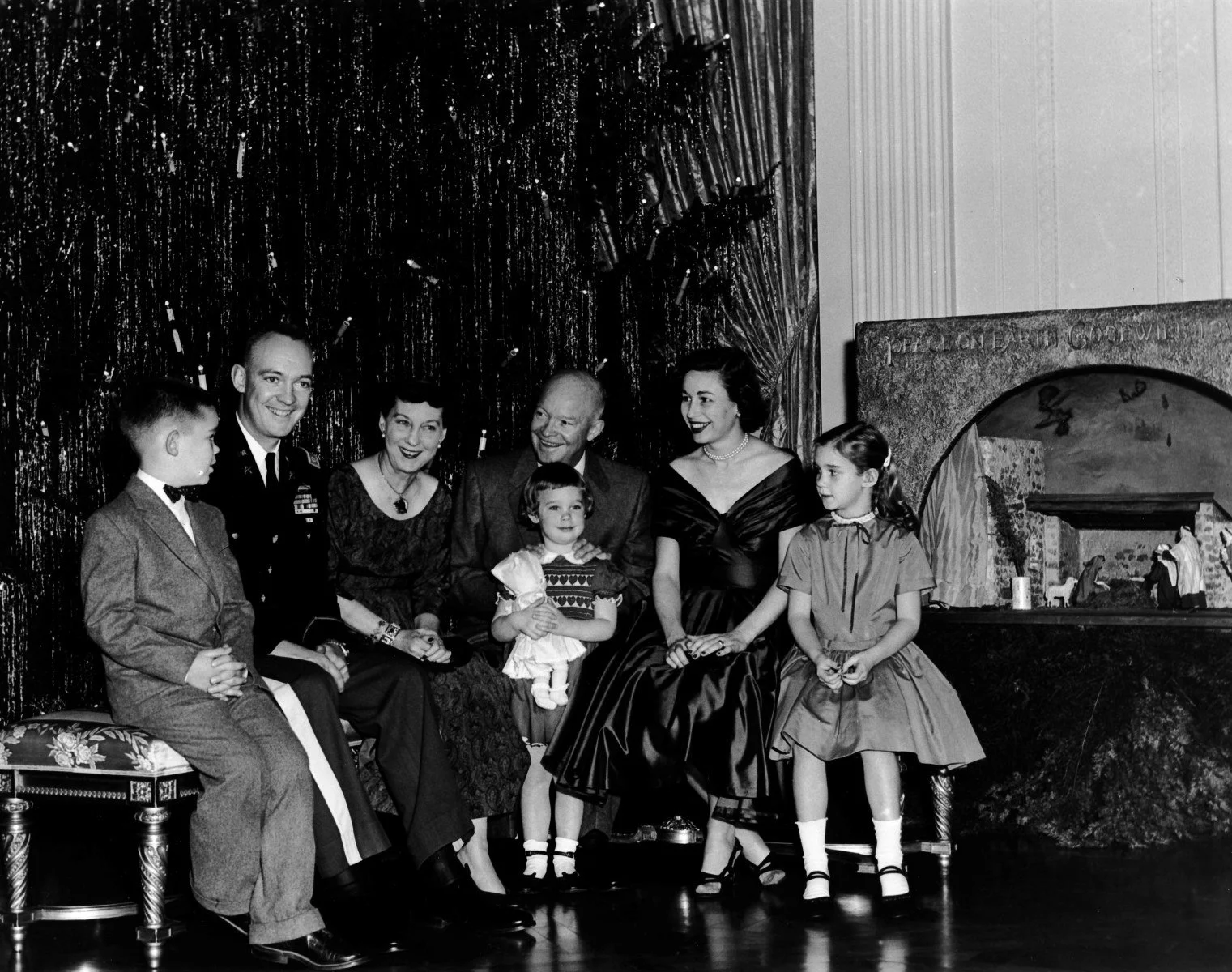
Eisenhower and family at Christmas.
Mis- vs. Disinformation (And Seth's Dyslexia)
Bob said misinformation and disinformation just seem like different types of information—trustworthy versus untrustworthy.
Seth unpacked disinformation as when information becomes misleading because of a misunderstanding, an oversight, or misinterpretation. While misinformation is deliberately trying to mislead.
Tim pointed out he'd always heard the definitions exactly the opposite.
I think Seth's dyslexia might have reared its head on this one. One stinking letter, folks.
Bob set aside that we still haven't defined what information is. And though we've had numerous philosophical discussions about truth and reality, he didn’t really want to bring those into this conversation. He wanted to focus on how someone’s disinformation could be anothers only information. We're not always aware of what type of information we're consuming. Bob would prefer to call all of it simply information.
Seth said information ends up spilling into truth. Because there’s the principle of correspondence between the mind and what seems to be the case in the world.
This got Bob thinking about his keto diet. Cause, there’s nothing like a good correspondence between the mind and the world to get your appetite going. The diet is similar to paleo diets and primitive ways humans ate—roots, berries, and the occasional gigantic hunk of meat. Before agriculture, there were no carbs. Bob grew up learning that carbs were the big thing we needed for nutrition. Remember that little pyramid the government put out teaching us about nutrition, and the main thing you were supposed to eat was carbs, it was the biggest part of the pyramid.
Today, it turns out that pyramid is exactly wrong. Check out a visual history of food guides here.
What kind of information was that? How do we account for what we think we know that changes over time?
History Keeps Changing the Questions
Max took the reins, “We're talking about what it was and what it is now. This is part of how we understand history.” Max happens to have a degree in history, by the way.
He talked about how people used to think they knew everything about the French Revolution. Then one day somebody asked: what about the women? That one question opened up a slew of new questions and investigations.
Trustworthiness doesn't necessarily happen because of who gatekeeps, but the gatekeepers do change how we think about things.
He told us about Madame LaLaurie in New Orleans who was notoriously cruel—the worst slave master known in the area. Sidebar here, for any of you popculture philosophers, LaLaurie inspired season three of American Horror Story. The luminous Kathy Bates was creepy af in that role. Lalaurie (the real woman) was so terrible AHS didn’t even have to embellish the acts of cruelty to turn it into horror. (The treatment of Madame Laveau in the show does a lot of twists and turns away from the real woman, but...I digress) Now, back to Max’s point. LaLaurie's story used to be told simply as the legend of the most brutal slave owner in New Orleans. Until one day somebody asked, “Why did she think she could get away with it?” That question changed the conversation and historians began examining what the role of white women was in the institution of slavery.

Kathy Bates as LaLaurie on Season 3 of American Horror Story: Coven
But, Max continued, we're always left with the problem that without the experiences and context of the time or the questions to ask it's hard to really ever say we understand.
What’s that?Aanother Philosofarian has lifted up the importance of the question! Should we have badges? Just a question mark badge, like the Philosofarian equivalent of a gold star. It could go along with the definition torch, if you’ve been reading these reflections since the beginning.
Seth said the thing about information is it’s rarely simple. It reveals new possibilities as we encounter it. It's part of why it becomes political—its complexity allows information to be used in different ways. Seth beat Bob to complexity, iykyk!
The Problem of Scale
Jan was tackling the idea of information from the lens of primitive social groups. We all used to live very far apart from each other in very small groups. Knowledge could build and be shared in small groups. And when these little groups met up knowledge could be passed on or we could kill each other for their stuff. But the struggle today is trying to be a great big group of people trying to turn information into knowledge and turn that wisdom. We’re such a big group this is really really hard. Especially now, when entertainment and information are being treated as the same category. Dolla, dolla bills y’all.
Asha joined in on what she called "these three people's train" that would be the Jon, Jan, and Ryan train. She was related to Jon's thinking that numbers have to speak for something to be believable, Jan's idea that the groups sharing information are just too big right now, and well, Ryan's story about someone wanting to buy his name.com. He’s got a ticket to ride.
She said in America, it easy for people to discern a dollar amount at the end of somebody's name. Other values like kindness, humility, honesty aren't as easy to pop on the end of a name - it’s hard for those values to be recognized beyond 100 people. And drumroll please, if Bob has complexity and definitions, then Ahsha has staked her intellectual territory with the concept of…narrative. She says we're all fighting for an agreed-upon narrative.
Seth asked why narrative? Knowing this is one of Asha's core ideas to play with.
Tim offered, “Information needs context.”
Asha said no, that's not what she was getting at.
Tim explained that he defined narrative as that which gives context.
Asha understood what Tim was saying, but still disagreed with this simplistic framing of narrative.
To which Tim lamented the trouble with definitions is they rarely solve anything. Which is true, but I think it kinda missed what Ahsha was trying to lift up. Tim’s take on narrative is part of what Ahsha was pointing to, but how and what narrative is and does is an idea that she’s been reflecting on for awhile. It’s been developing and growing in her thinking since she started coming to Scoundrels a few years ago. It’s something she’s been working out the nuances of why and how it’s such a powerful and integrative lens to use when thinking through her ideas about the world.
Asha took another stab at trying to get to the heart of what she was trying to say by going back to what Jon said—that he needs math to make sense of information. Connecting this to what Jan said about our 100 person limit for shared knowledge, and how when we live in bigger societies, we need the myth. We need the agreed-upon narrative to make sense of things.
Seth saw for Ahsha it is context, but it's also more than that. It's a treatment for how we take information. Not just its context, but also our disposition toward it in the first place.
Half Baked
We didn't fully explore:
What's the relationship between a community and its gatekeepers? If the audience determines curation, how do we make those decisions?
Is it avoidable for valued (of any type) information to become corrupted? Seth wondered if the very nature of information being able to be valued will always carry with it the possibility of corruption.
What is information for? What does it do?
Max brought up the Somali daycares story and how erosion of trust creates a competition to confirm narratives with our own cameras. Balance is not only in the information—it's also in the person receiving it. They're part of how balanced information may be. How does that relationship work?
Ryan brought us back to the controlling narrative of 1984 and the goal of consolidation of power. He slid in a joke about North Korea’s notoriously free press (geopolitical humor for the win). Being able to control the narrative is one way to consolidate power. Asha with characteristic enthusiasm asked how far along Ryan thought we were in this consolidation process. I wish he would have responded, “I’d tell you, but then I’d have to kill you.”
Dale shared his understanding of journalism: a headline should convey the whole story in one line. When it doesn't, it's not journalism. If you have to click to get the whole story, it's more about money than information. If he really wants to understand climate change or how drugs work, he can dig into the data. You can't do that for everything. You can trust that 97% of scientists agreeing makes it easier to believe. But when the data's not available, that's when it's time to get suspicious. It brings up more questions about the nature of gatekeepers.
What We Know We Don't Know
Seth brought us home with a jaunt down heuristic lane—one of his favorite words. It's a mental shortcut that helps us come to a conclusion. Super helpful in complex societies, but also crazy susceptible to bias and corruption.
Asha talked about narratives → Seth was thinking beyond narratives into ideologies. When we hold beliefs not because of any logic, but because of politics or religion—ideas we keep for non-epistemic reasons.
As society becomes bigger, it becomes more beholden to our access to reasoning. Because the shortcuts create a decline in our agency—of our communities, and even of us individually.
And now for a little rapid fire odds and ins of thought also on the table tonight.
Seth brought us back to C.S. Peirce, one of the founding pragmatists, famous for his fascination with belief and how to make our ideas clearer. Peirce's approach was to get out there and live. But we also have to be able to test information. However, people react against this idea too.
Tim said information becomes knowledge when it's relative to a framework.
Seth said that information should be grounded in knowledge, and knowledge needs to be grounded in wisdom. We need to keep these three working together.
David said information provides agency, and that can be both good and bad. The line "I know where you live" can go either way. It's probably not good if everyone knows how to make anthrax. On the flip side, it was a specific strategy to keep enslaved people from learning in order to enforce the institution of slavery.
There was no consensus. We need filters, but filters can be corrupt. We need trust, but trust can be and has been eroded. Information has always been limited by the mind that holds it and the mind that receives it. Money corrupts information, but maybe value itself is the problem. Scale is the problem. Or maybe scale reveals the problem.
Maybe we need to get smaller. Maybe we need better shortcuts. Maybe we need to stop treating entertainment and information as the same thing.
Maybe we just need to remember that Jane wants to buy back her own books.
