
Spiderthink was supposed to be cooler
We were a big group last night. Whoa. I was stealing chairs left and right from upstairs. Peter was back with definitions. CJ was back after a decade away. He had newcomers, the rest-of-us-comers, and a guest philosopher, oh my.
Seth opened by pointing out the question itself suggests a paradox if we imagine the limits of imagination, then we are already within imagination therefore suggesting that there are not limits…but are there? We spent the evening circling around mathematics and panpsychism, neurons, novelty, spiders, and serfs, trying to figure out whether imagination has boundaries—and if so, what kind?
Here’s the threads that seamed (see what I did there?) to weave together.
The Math of Finitude
Tim kicked us off with some genuinely astonishing combinatorics. Using the number of synapses we're known to have, he calculated an upper bound of 10 to the 48,240 power. Then he approached it from language—using GPT-4's tokenizer with 100,000 tokens—and came up with another number: 10 to the 81st power. He factored in that neurons fire at 200 to 400 Hertz, did more math, and concluded it would take 10 billion billion years to imagine every possibility.
His conclusion: imagination is unlimited in terms of any human ability to reach any of these bounds, but it is finite - according to the maths. Everybody clapped.
Seth added a caveat, that this lovely math presumes thought comes from a neurological perspective. Thinking about thought from a neurological perspective is one way to consider imagination and there are other ways too.
Bob pointed out that while integers like 10 and 81 seem graspable, 10 to the 81st is not as small as it seems, in fact it’s ginormous. We tend to look at two little numbers like 10 and 81 and think oh, yeah that’s big, but not that big. How big is it? Well for one thing it sure gets bigger if I type it out. Going a little cross eyed with zeros does drive the point home a little more, I think.
10 to the 81st power = 1,000,000,000,000,000,000,000,000,000,000,000,000,000,000,000,000,000,000,000,000,000,000,000,000,000,000,000
There's a function to our embodiment that makes it really difficult to actually imagine a number that big. So the math says there's a massive number of possibilities, but because of our embodiment, our capacity is actually infinitesimal.
So, imagination is mathematically finite in principle (presuming neurology), but functionally infinite for us.
Language as Prison and Portal
Tim brought up how we can't separate cognition from language—that thought itself is constrained by the language we have.
Some in the group were familiar with this idea, others were of the opinion this was cuckoo. Thinking is so much bigger than words, because as Emily put it, what about things without language? They still imagine (at least we imagine they do).
I remember when I first encountered this idea and had the same reaction. I was sitting in class and thinking that’s a stupid idea. Clearly, we don’t need language for thought. If that was the case then you’d be telling me ants don’t think. Baloney, they just do it differently, like with chemicals. I was making a mistake in my own thinking about language. Kenny brought up the point I was missing way back then a little later in the convo, that language is more than words. Cause, you know philosophers be exploding all the words and ideas always, lol. Ahhh…younger philosophical rookie me made way more assumptions - I’d pinch her cheek now and she’d roll her eyes, cross her arms, and argue with me.
I think Emily was making a larger point than I was back then. She was lifting up a different way of defining consciousness. Coming from a perspective of collective consciousness, it’s not just that language wouldn’t restrict imagination, it doesn’t really make sense. You could look at it a couple of ways. If consciousness is collective, then there’d be a way that all the language there is would be accessible to all that there is. So even if it was a limit, then it wouldn’t be any sort of meaningful limit because the limit would still include everything. Another way to look at it, and I think Emily was coming from it more along these lines, is that consciousness is something that is bigger and outside of us and her experience as a synesthete meant that she’s thought in colors before so why would we restrict what’s possible to words?
Seth offered panpsychism as a reconciliation—the idea that consciousness isn't unique to humans or animals, but is a fundamental feature of reality itself, that everything from electrons to plants to planets has some form of experience or mind, however different from ours it might be. If consciousness is a natural force that expresses through various forms, then both Tim and Emily are right. There's plenty out there beyond us, and we'd have no way to conjecture about it due to our own limits.
Our guest speaker, Kenny Knowlton, brought up Benjamin Lee Whorf and the Sapir-Whorf hypothesis—that language preconditions what's possible in our imagination. At this point, Kenny and Seth nerded out about Benjamin Whorf for a few moments, and I was totally amused because I didn't know who Benjamin Whorf was. I just knew Worf from Star Trek. So I literally thought while they were having this conversation and that they knew an awful lot of Star Trek lore, and I was cracking up. But it turns out I'm the Star Trek nerd, not them—this is a real guy who was a real genius who worked for an insurance company and did all kinds of stuff with language.
Kenny was lifting up the recent revival in philosophy around Whorf's ideas. Dale had said earlier that 4,000 years ago, imagination would have been different because our environment places limits on what we can imagine. Kenny connected this: it would be very difficult for us to imagine what it was really like to be a serf, just as it would be hard for a serf to imagine a 747. The limit of imagination and the limit of experience work together.
Pete brought up an interesting texture to the language as thought perspective. He started with you cannot have language without thought, but you can have thought without language. Then he noted that we use analogies to understand—but we also get trapped by them. We can't experience an atom, so we make models. We put colors on atoms, but we don't really know they're there. It doesn't even make sense to think of color at that scale. What sorts of analogies are we trapped in everyday we don’t even notice?
The Bat Problem (and the Spider Problem)
David usually begins to wonder about animals when he starts thinking about what a human couldn't experience. There's no fish poetry. You can't teach a cat calculus. (Don muttered under his breath, "Well, you can teach it, but it probably wouldn't learn." Don has opinions about cats, as we learned a few weeks ago.)
Tonia brought in Thomas Nagel's "What Is It Like to Be a Bat?"—one of those philosophy pieces that's frustrating. If there are things you can't experience, then who the fuck cares? But also, for Tonia, it’s the “deliciousness of the wanting” to know that’s the really interesting part.
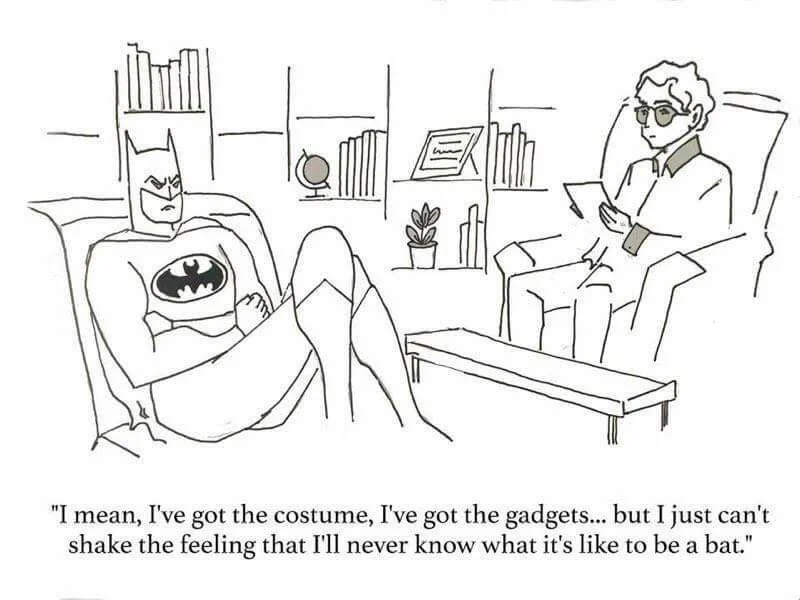
Nagel’s point.
She mentioned the book series Children of Time, where spiders are accidentally infected with a virus and develop intelligence. She got excited about spider thinking—what would it be like to see the world with eight eyes, to sense vibrations across a web, to make silk as a biological process? I made eye contact with her at this point because we both love spiders, and she gave me a little knowing nod. But then, she talked about how disappointing it was when the spiders just had human thoughts. Total let down.
This reminded Seth of a Wittgenstein quote, "If a lion were to speak, would we understand what he had to say?" There are ways that there are things we can't consider. But there's also this stochastic nature to it, where new things are coming up all the time. Which brings up the question, what can Possibility actually do?
Culture, Environment, and the Shapes We Can't See
Dale considered how much our culture and environment shape what we can imagine. Emily, as a synesthete, really agreed—our environment informs our imagination because we're not separated from it to begin with.
Kenny was thinking about how you could connect the limit of imagination and the limit of experience. Part of what makes the 747 impossible for a serf to imagine is a limit of experience.
Emily asked: through globalization and new experiences, does each new experience exponentially expand the possibility within our communities?
Kenny responded: absolutely, and he loved that she used the world “possibility.” Because, yes,it's a possibility—but not a certainty. You could encounter people with different experiences and take away no understanding, gain nothing from it.
Emily pushed back gently, even if somebody doesn't take away the full experience, the very experience itself has still been expanded simply by being encountered.
Filters, Combinations, and the Default Mode
Bob recalled an experience traveling in New York with somebody doing methadone who was hanging out the window seeing colors they'd never seen before—colors they couldn't describe because they'd never seen them before. (Bob made it very clear he was not partaking.)
This reminded Seth of the dress that broke the internet ten years ago. Several of us took a moment to process that that was already 10 years ago and felt a little bit old. Seth’s point was our brains just fill stuff in—whatever color you saw that dress first, it was really difficult to ever see it the other way.
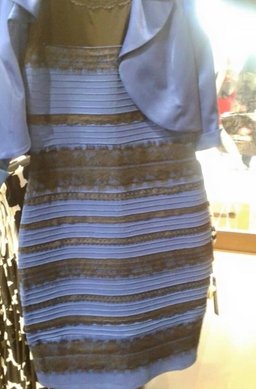
Blue and black or white and gold?
Tim brought in that when you look at models of evolution and animal intelligence, the one thing that appears to define us is our imagination—and something very particular about our imagination is its ability to consider a complex array of counterfactuals. Then he shared that he'd done a lot of psychedelics (when he was younger of course). I couldn't help but notice that there was some surprise in the room. I'm always delighted when we learn new things about each other, when we chip away at the assumptions and ideas we're building. Turns out you can be both a mathematical, analytical thinker and someone who did a lot of psychedelics in the 70s. Indeed, the thoughtful party animal is a bit of a philosopher archetype- I’m looking at you Socrates, Hume, Marx, Sartre, and de Beuvoir.
Tim said psychedelics show us how much we just make up. There's real value in recognizing that so much of what we think is real is just stuff inside our minds. The work comes when you're no longer on those drugs, making whatever changes or shifts accordingly.
When Imagination Turns Dark
CJ was thinking about imagination as a download from something much bigger—she's been reading The Biology of Belief and thinking about these big downloads of new ideas. But she was also interested in when imagination can take a negative turn—when it turns to worry or rumination.
This was a fascinating take. Seth and I watch our kids begin to ruminate and see how they can get stuck without a little bit of extra help. We didn't follow this line quite as much as a group, but it's a fascinating idea to explore—we'd largely been talking about imagination in this positive way, but there are these other aspects that aren't necessarily great. Jane would bring us back to this later.
My Idea and 50 Cent Philosophy Words
I'd been brewing up an idea that was kind of different from how we were following imagination. I was thinking it's not so much that imagination is possibility, but rather that imagination is limits. Because we are embodied we naturally see and think in limits. We are fundamentally limited, so limiting is a feature of how we think
I was limiting (haha) my idea to just human imagination. For us, imagination is the act of limits expressing through our consciousness. Imagination is a recombination of limits that we’re assuming all of the time. We’re constantly categorizing, labeling, and these are both features of limiting. We can move limits around to think of different limits. I could limit experience to colors, limit colors, to pink, limit pink to red and white, limit red and white to types of frequencies, limit frequencies to particles when I limit space or time. All we do is limit and when we imagine, what we’re doing is playing with limits, limiting limits with different limits.
Seth thought that was an apophatic way of looking at it and asked if I agreed. I said, "I don't know. Define apathetic." Spellcheck’s got jokes- apophatic is what I really said. So he did. It’s a term that gets used in theology a lot. It’s when you define stuff through negation. Cool word. But that's not what I was saying. I wasn’t saying we imagine through what not there or what we can’t see or think. I was saying that the nature of the way we think is fundamentally through limits, so imagination has to be for humans at least an expression of limits. If I really slow down and think about it. I guess there’s a way that what I was saying could be apophatic (you know I like to disagree with Seth), but only insofar as humans being is necessarily apophatic because we are embodied. Hiii-yah! Karate chop that apophatic.
David was then thinking about how to pull these strands together—my idea about limits as a kind of filter, to Tim's combinatorics and the methadone influenced car ride Bob experienced.. David knows of psychedelic research that shows psychedelics shut down the default mode network in the brain. That network acts as a filter. Speaking to the combinatorics: there are probably a bunch of combos that are just crap, like "banana water pipe" and our brain filters out all of that. Maybe that left us with what the potentially useful or interesting things were. Seth asked what "useful" means here, and David said, well, something coherent, probably.
Poetry, Coherency, and What Works
Seth brought up that it's interesting where things become pronounced—where there's new and meaningful coherency. One place is poetry. It's circumscribed and bracketed by language, but there's a lot of not-very-good poetry out there. He subscribes to poetry.com and reads a poem every single day. Maybe he keeps one in 300. When you see a poem that works really well, you just know it.
Jane said because it stimulates you.
Open Questions
There were several threads we didn't pull all the way through. So many ideas, so little time
Jane asked: what's the difference between imagination, conjecture, speculation, and creativity? Why do we give imagination the more positive emphasis? Tim offered that perhaps they're different facets of the same thing.
John, a programmer, said he'd always been a logical guy and programming is always trying to simplify. He thinks imagination might be reducible to "what if." Without desire for change, is there no imagination?
Tonia asked the artists in the room: how exactly do imagination, creativity, and in particular novelty work for you? Don reframed it: for him, coming up with an idea is easy—he dreams it. The art is in having to manifest it.
Thom brought up the term "moral imagination," which got an audible gasp of delight from the group. Seth explained that moral imagination is a term ethicists use to talk about what we mean when we imagine what has value or significance, why we take action. Thom had also been reading Richard Dawkins and learned that's where the word "meme" came from—The Selfish Gene—and he was working on connecting a self within a self to imagination, but we were already past time.
What We Know we Don’t Know
It was lovely to have Pete back, because he does like to take a stab at a definition. What he offered was this: maybe imagination is an active expansion of reality.
There was no consensus. Imagination might be finite in principle but infinite in practice. It's shaped by language, culture, environment, and embodiment. It might be something we do, or something that moves through us. It might be limits expressing themselves, or possibility reaching beyond what we know.
Seth mentioned Kant: our minds want, but they also have limits. And yet we're also aware that there's stuff we're not aware of.
Jim said imagination is to dream—it's less numbers or language and more about what you want to do. Seth agreed and asked what directs it. Jim said its environment.
CJ believes the universe is expanding, creating, conscious and that we can communicate with it.
Maybe they're all right.
Shout out to the quiet ones! I see you, too.
Next week at Scoundrels: Where is the healthy balance between openness and restriction of information in society? Wednesday at 5:30 pm, Bridge & Tunnel Bottle Shop in the back. Come think with us.
