
Scoundrels Discussion — February 24, 2026
Last night we asked: What exactly is death?
Eighteen of us in the room (if you don't count me and Seth). Welcome Sally! Sally's visiting from Eugene where she runs her own discussion group with a cool twist—they throw out a topic, everyone goes down their own rabbit hole for a month or six weeks doing their own research, and then they come back together to share what they learned. It sounds like intellectual show-and-tell for adults. Thanks to Asha for bringing a friend. And welcome Robert another friend in the group. So many friends, so much conversation. And hello Ryan, it’s been a minute good to have your thinking in the mix!
Seth kicked us off with another chestnut: What exactly is death? Chestnut is the new “teleology everybody. This is week three he’s used it. And yes, I’m keeping track! Back to the topic at hand - the question seems obvious, death is the end of life. But like time, the more we look at it, the trickier it gets. Death doesn't seem to be anywhere or anything. It seems to be happening all of the time. Also, all consciousness and everything is always passing into oblivion always. Which means every moment is death. But is it real? It's all that ever can be. Further, there are traditions where death is seen as an illusion, the self not destroyed but transitioning into another existence. Not an end at all.
So here are some questions: What can die? What can't? What are the qualities that preclude the possibility of death? Maybe numbers can’t die, maybe they are more like principles of the architecture of the universe rather than something capable of death. Is death inherently related to life? Does it shape the way we think of life?
Seth mentioned Heideggar and the possibility of impossibility. It's not clear death is real, and it’s not clear it couldn't ever be real, perhaps it’s just a perspective. Since it's so difficult to even imagine the unimaginability of it, why do we care about it so much? He referenced Nagel's idea that death is bad because it's the deprivation of future goods (if you want to do a little philosophy nerding, this is called the deprivation account).
Death is a mystery. What is deathless existence? Seth gave a talk a while back about immortality and how it shares the same kinds of problems as the idea of deathless existence. Immortality is unimaginable. What would a self of a billion or a trillion years old be? What would it mean or do to you to have a memory with that expanse? Whoever you were to begin would cease to be at some point. So what is death?
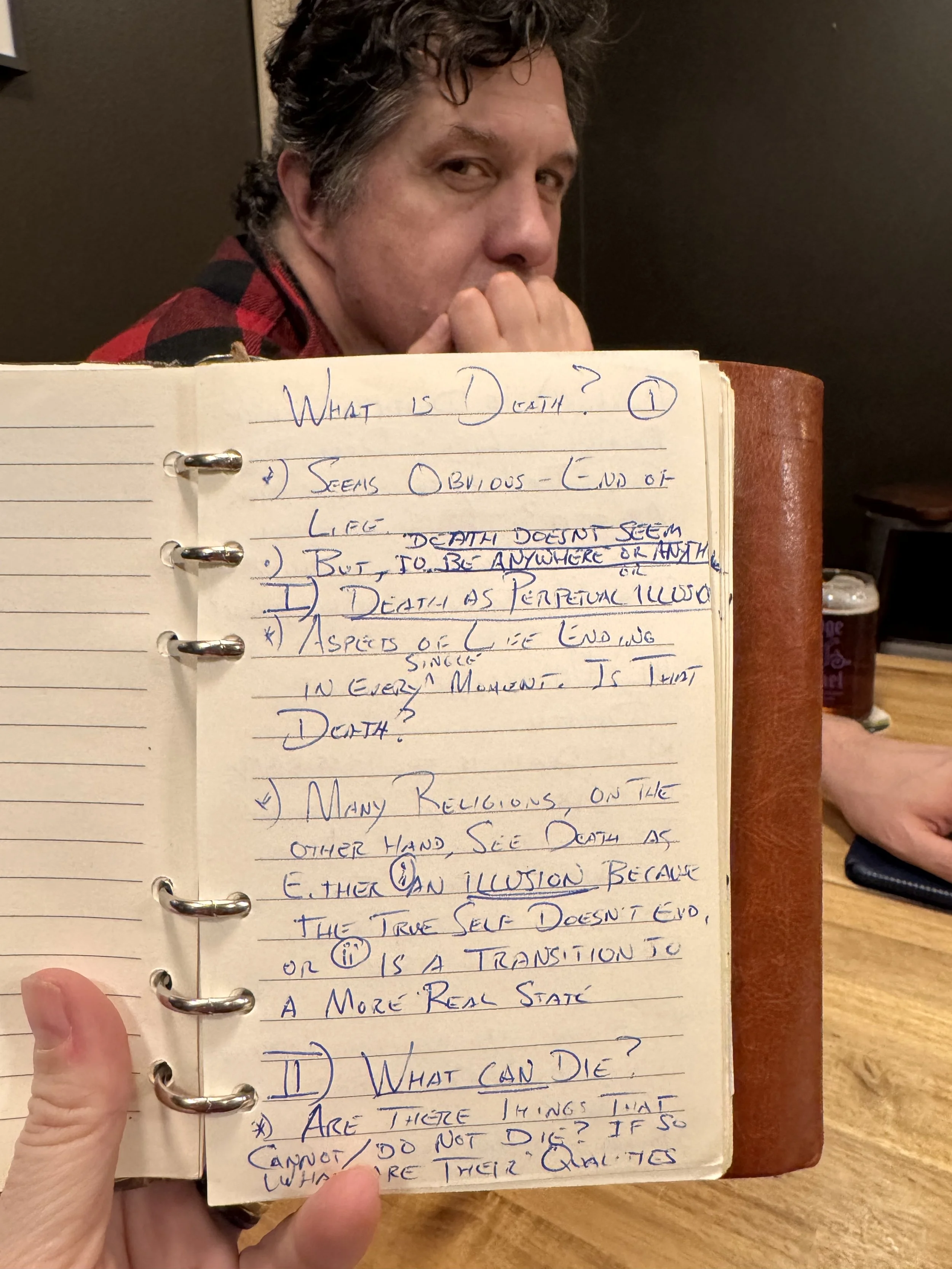
A snapshot of the kickoff.
When Does Change Become Death?
Pete said, "I can't believe you used the word 'exactly' in the question." Welcome back Pete!
But he took a stab at a definition anyway, because he always does. Death is the cessation of a life or vitality. And if the definition of life is change, then death is the cessation of change. With numbers, there's no vitality. There's no future or past.
Seth was intrigued. He asked, if death is the end of change, then what is change? Or is it that death is just noticeable change? In Buddhist thinking, death is not different from change. The difference is that it’s a more noticeable change to us.
Ahsha liked Pete's idea, but she thought maybe death is the end of change with agency. Death brings the mushrooms to life. It's the consciousness and the willfulness that has shifted. And guys, I know the mushrooms will continue to thrive in this conversation, but I want to take a moment to share with y’all, if you want to see Ahsha glow: talk about mushrooms. She is a bubbling fountain of enthusiasm when it comes to the great wonder of mycelia.
Seth asked, why agency?
Asha replied that's what gives it meaning. She said she was stealing Pete's ideas from their pre-game talking. It seems like this conversation will ultimately lead to talking about what is the meaning of life. She referenced Willie in Lincoln in the Bardo who was decomposing in a coffin (sickbox) being eaten, but recognized he still had a choice about how to feel about it.
Agency is important because it gives meaning.
David thought life is the idea that self is a process. Pete is Pete-ing and Seth is Seth-ing and Asha is Asha-ing. Death is the end of a process (a process processing?).
Max pointed out we were focusing on physical death, but other things die also. Ideas die. Or live on. We're here talking about philosophical ideas that live on. We get focused on the physical, but people also talk about ego death, part of our self dying, and also the idea that death is a kind of birth.
Seth asked, when an idea goes on, how does that happen?
Max thought ideas that follow a universal are what people keep thinking about, they’re the ones that live on. He brought up the example of immigration—we've been thinking about and talking about this since at least Shakespeare's days.
Ian McKellen performing Shakespeare on immigration.
Some ideas are specific to the times they live in, like the philosophy of castles. That's gone. But the philosophy of architecture can last because we haven't stopped building. We just don't really make castles anymore.
And Luka brought up the idea that death is the experience of the observer. It's the concept of an idea, of an era, rather than something more esoteric. Death is something the living experience. We presume the dead don’t.
But What About Ghosts?
Seth said Epicurus talked about death in the way Luka was describing. If there's anything to compare what death is, it's to compare it to what it was like before we were born. Worrying about it is foolhardy. But Epicurus thought the impenetrability of death could be lead us to living skillfully. In being aware of the character of death and allowing it to simply be that which we cannot conceive. Freedom is in letting go of the fear of death.
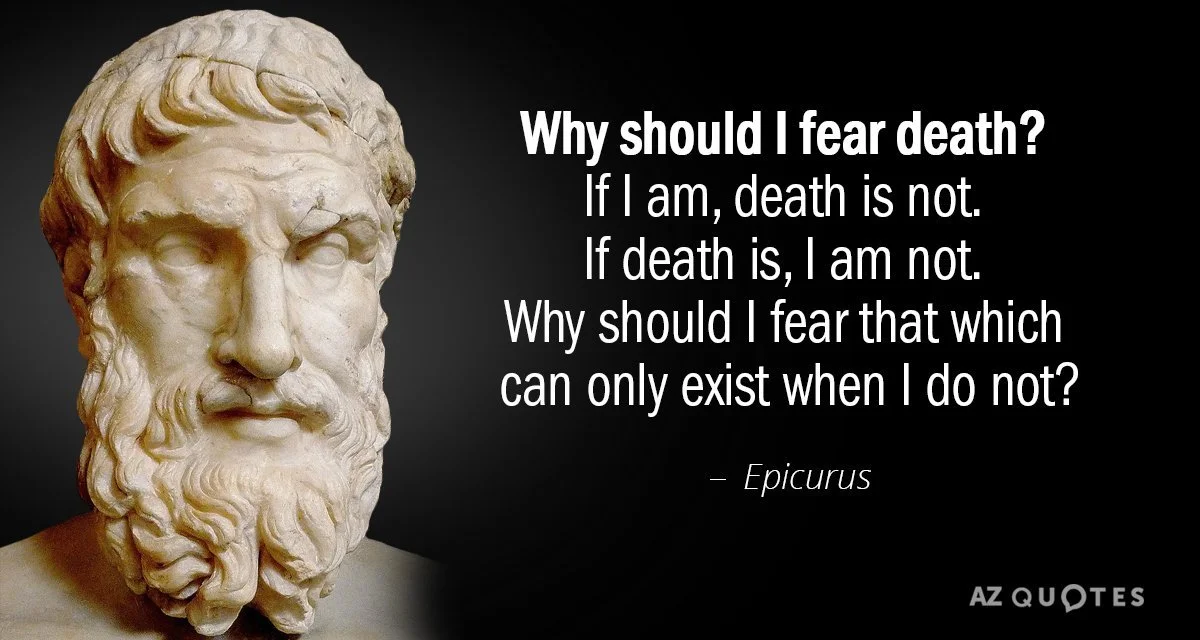
Pete brought us back to the fact that we were trying to find an exact definition, and he was thinking that ghosts throw a wrench in the works. Because if ghosts haunt us, if anybody's been visited by a ghost, well then they can let go of the fear of death because we know it's not an end.
I was thinking—when Pete brought this up—that it kind of depends on what you think ghosts are. I tend to think of ghosts as something, someone, or an idea that's stuck. Something that is attached and cannot continue. And that idea is kind of scary to me. I lived in a house as a teen with a ghost. Her name was Serafina, she died in the house. Her dog still lived with us. She was pretty benevolent. EXCEPT when her ex-husband (our landlord) came around. Oh man, all sorts of stuff would happen with him around. Doors would lock behind him. Cabinets would bang. The lights wouldn’t turn on in the utility room. The washing machine wouldn’t work until he left. She left her house to her son, who didn’t want to take care of it. She was real mad about that ex-husband in her home. On a regular day, if the lights in the utility room didn’t turn on, we could say Hi to Serafina and ask her to let the lights shine and they’d go on.
So the experience of meeting (and living with?) Serafina was honestly a little funny as a teen. But if I look at it with the idea of being stuck or holding on to something so much that it could bind me to space without materiality. It is kind of scary. Sort of like the dark fairy tales meant to warn you about the consequences of vice. Imagine holding on to transcendent hate. But when I turn that idea around. That what we feel could transcend materiality, it could also mean that a ghost might stick around for virtue also. Like Willie in the Lincoln in the Bardo - his great love of his father was holding him in purgatory.
If I hold these two ideas next to each other, that a vice or a virtue could both transcend a body or the material plane.Then I see ghosts as grotesque. Grotesque in that an experience, feeling, or value becomes the entire essence of an identity. That it could be what makes for the possibility of the existence of a ghost at all.
I take Pete's point that if ghosts maintain a consciousness that expresses a continuous self, it should alleviate the fear of death. What I see in ghosts is txche reminder to be mindful, even if that consciousness continues it can become so grotesque that our conscious expression is immaterial in a material space.
Yeah, so I was thinking through that, trying to keep up with taking notes on the conversation.. Not easy, guys. I get distracted sometimes with my own thinking and have to remember to take notes again. My notes on Seth's story about the ghost is literally "six years old, ghost, pissed." That's all I wrote down. If the story actually ends up in my final draft here, you know that I had to ask Seth what the story was again because I was over here thinking about vice, virtue, ghosts, Serafina and the implication of grotesquery… and not really paying attention to Seth's ghost story at all.
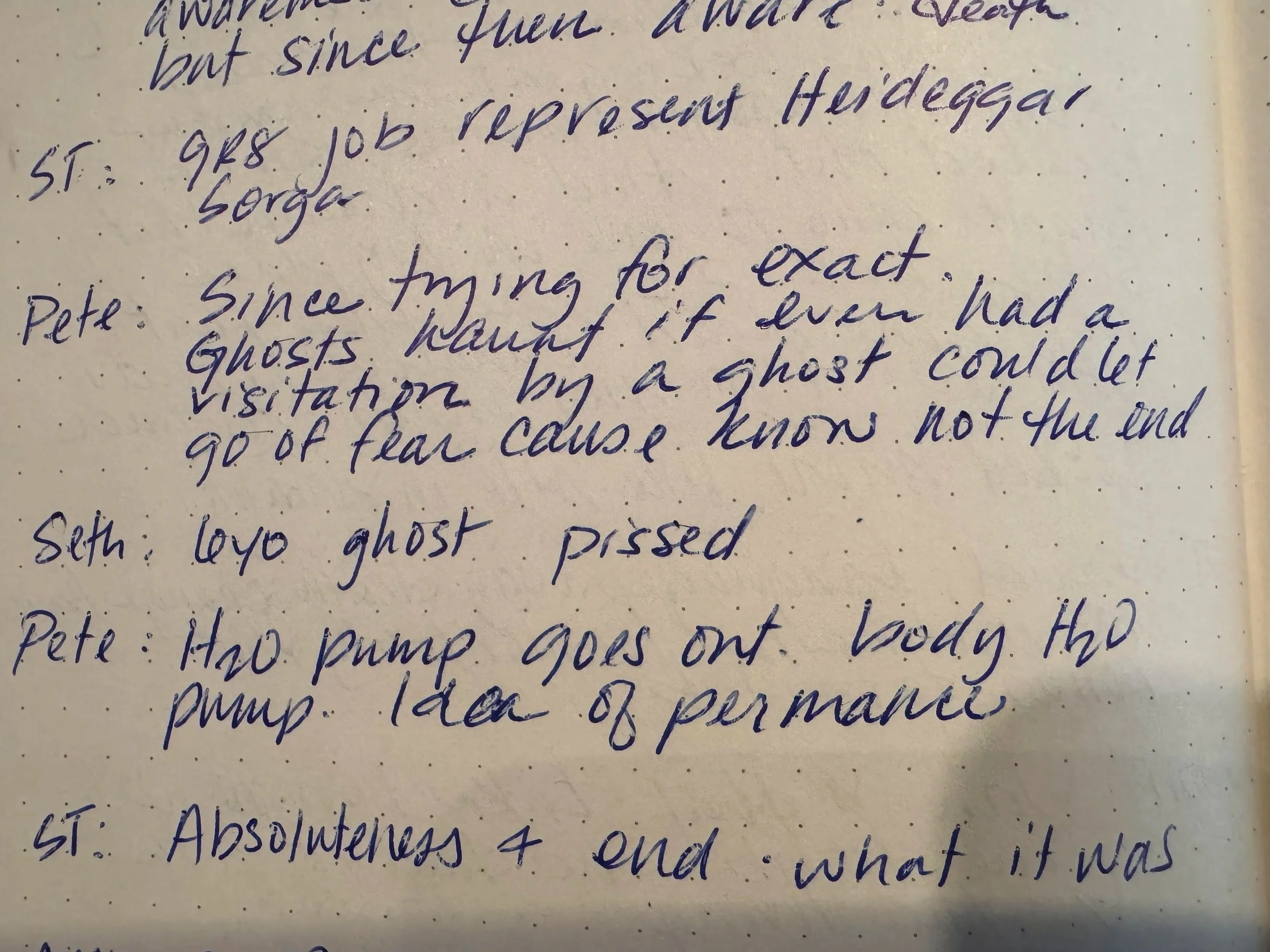
Proof.
Jan's Dream and What We Hold
Jan shared an experience she had years ago that was puzzling for her. Her mother-in-law passed away in bed. She had been sick. Her family knew she was dying. And Jan was the one who found her in her bed, but she didn't think that she was dead at first. Her mother-in-law's eyes were open, looking at Jan. Her head was up. But after a little bit, Jan noticed she wasn't moving at all. She went to touch her and recognized…rigor mortis. She kind of freaked out, but she didn't share that with the family. She just told everybody that their mom passed away peacefully.
That night she had a dream that she was in a big place, kind of like a warehouse, and her mother-in-law came to her and apologized. "Sorry you had to see me like that." And Jan experienced that her mother-in-law wasn't gone just because she was dead. Whatever "her" was, still was. Jan pointed out she wasn't much of a dreamer. And she noticed that her mother-in-law looked more like her mother-in-law in the dream because she did look different when Jan had seen her dead in the bed.
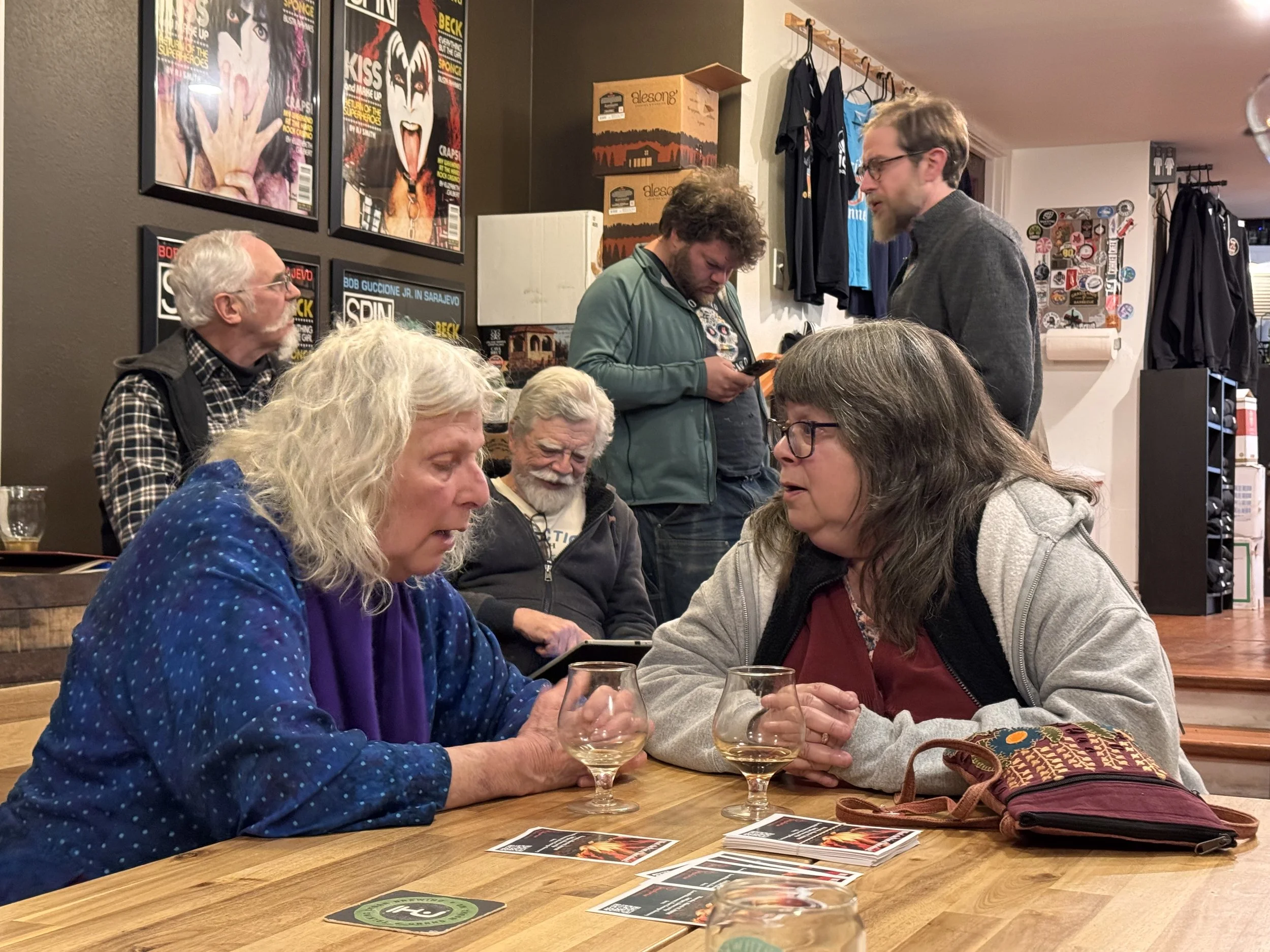
Isa and Jan in the foreground, Thom and Jon mid-ground, and Luka and David in the background.
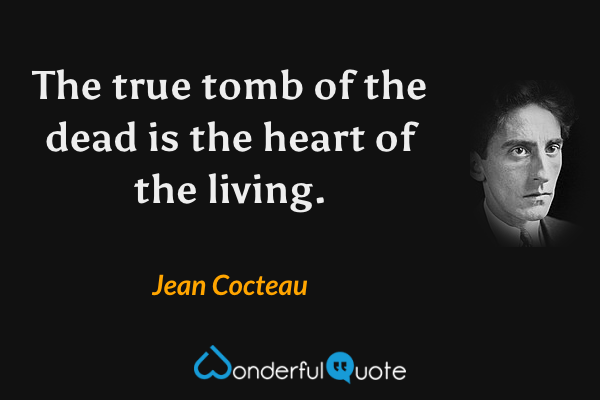
Thom loved what Jan was pointing out about continuity and how Luka had brought up death as an experience of the living. He recalled Jean Cocteau’s quote, “The true tomb of the dead is in the heart of the living.” He knows this isn't exactly a definition of death, but what we have and hold is what we took from their lives. For example, everybody knows who Lincoln was. He connected this to what Max said about ideas and the death of ideas and how good ideas don't end. That good is what persists in ideas. I asked what he meant by good and he said I knew you were going to say that! Lol. I asked if he meant good as in whole and complete or good as in moral.
And this is the point in the night where Thom began reminding us of "Who started it" In this case, Max started it—the good idea about ideas living or dying. You started it Max! Max looked startled. Barbara chimed in, "Well, he talked about castle design." I think maybe Thom was seeing how the deeper principles remaining over time that Max brought up in architecture vs castles was the good part stayed. I like how Thom always tries to thread together different thoughts the group has surfaced, adds a literary quote or an evolutionary biology/neurological take on the topic and then says something rowdy. He may be a pirate, but he’s our pirate.
Jane had done some studying before this session. She had a whole bunch of notes. She'd been digging into her philosophical studies before she came tonight, and she wanted to add some “basic things” she'd spent time thinking about (her words, not mine). She was thinking about what it would be to live without a sense of death. Death gives us urgency. We are time-bound. Different from how Nagel saw it as depriving us, she sees death as part of life. It's what gives meaning and awareness. You can't remember your birth, but ever since then you're aware of death. And this knowledge is what drives all of our endeavors. What we make, produce, discuss, or consider.
Seth applauded Jane on her representation of Heidegger's concept of sorge.
Who Gets to Decide What Death Is?
Andrew gave us a pop culture reference to dig into death further. I love that he does this because then I can always go look up something new if I haven't seen it. I tend to think philosophically through pop culture myself, so I always appreciate it when Andrew does it. He brought up the show The Pitt. There's an ER scene where doctors are working on a patient. There are a couple of indicators, and it's those specific indicators that are taken into consideration when the patient is declared dead. Andrew shared this to illustrate that our cultures pick what those indicators are. Breathing means X and your heartbeat means Y, but it's our culture adopting those indicators, determining that they are what we are calling death. We as a society decide how disruptive or calm the event of death is. He was raised to accept death as a finality. As a kid, there was never even an option like what Asha said that the living of you is next embodied in the mushrooms. Death is all about living. So he was curious: why do we keep picking versions of death that are so disruptive in our culture?
In case you’re curious about the show, here’s a promo. It’s a medical drama.
Seth unpacked how this is a particularly Western way of approaching death, that it's tied up in our concepts of individuality. There are cultures where a dead body is part of a longer story, there’s above that body, a plant that grows into a tree, and people picnic around the tree. Perhaps one day the tree burns and there are ashes, but then those ashes are used for something. We could think more continuously about death. He has several Chinese friends who could trace their family's lineage back a thousand years. They might have to go up to the attic and grab a box with the pieces of memory we hold to remind themselves of exactly how the line goes, but their ancestors live on as ghosts (new kind of ghost here). The ghost of your grandpa might live on in a turn of phrase or how you hold your chopsticks.
Ryan was compelled by the impact of how death shapes our life. Our life is sacred because of the timeline. But he started thinking: what's the role of death on a larger scale, like in the universe? It seems like death is a yin to a singular way the universe is seeing itself or expressing itself. We are all strands of the universe. All these experiences, these strands, are singular, even if they're shared, but the universe is always and eternally experiencing singularities of itself. Death is the finishing of these expressions. In this way, it's more obvious to see the necessity of it. The universe must continue expressing all the different possibilities of itself, and so there is this infinite, eternal expressing of singularities, which by their singular nature are finite, and must be for the universe to universe.
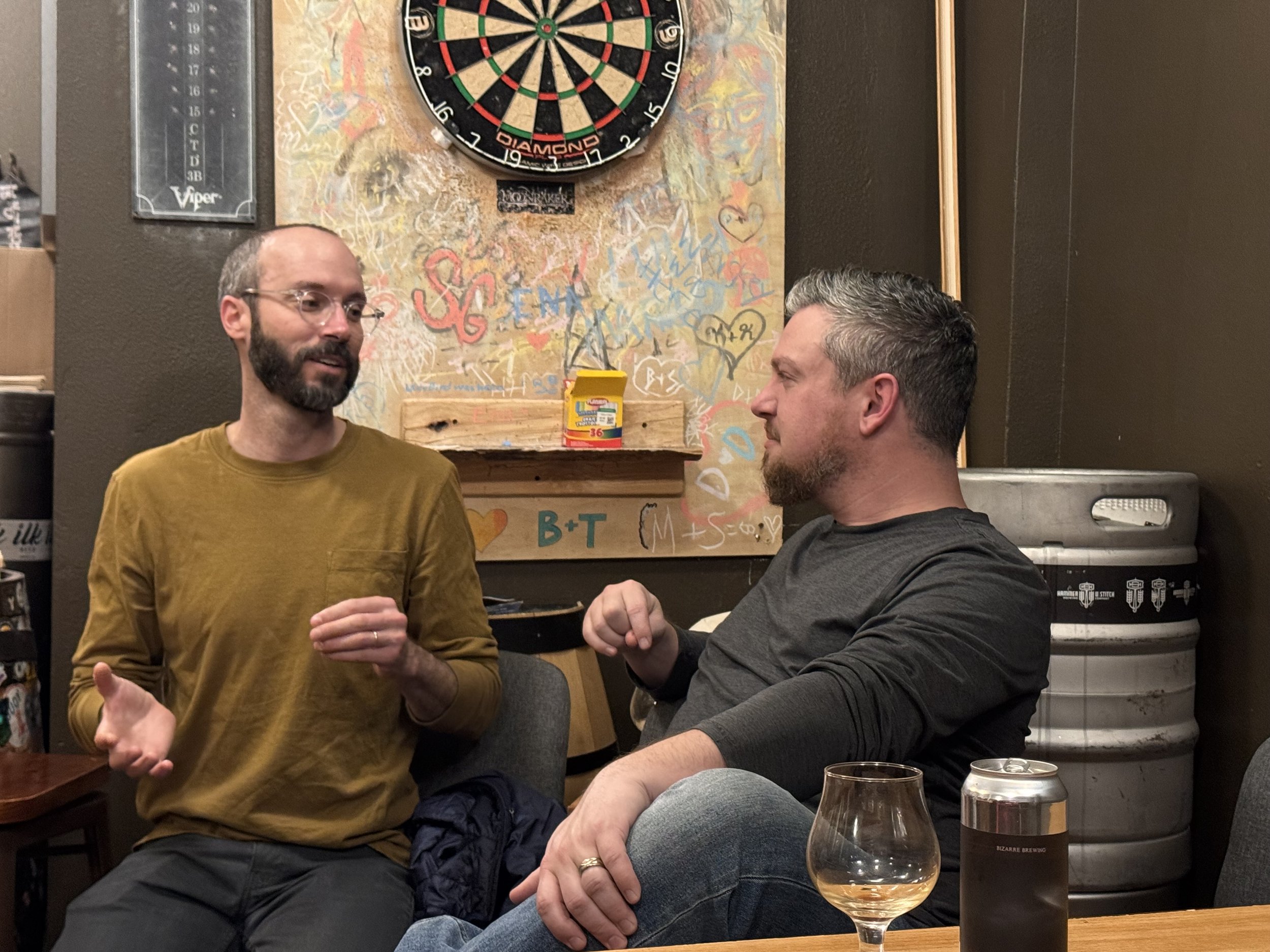
Andrew and Ryan.
Seth connected this to how Aristotle defined God—that God is thought thinking upon itself.
Total non-sequitur here guys, but it was precisely this idea in philosophy, Aristotle giving a definition to God, that changed my life. And it’s the reason I believe so deeply in what we’re building with Philosofarian. This was a huge breakthrough moment when I was younger. Like, oh, there's a million more ways to think about the world and to think about it more deeply, including the idea of God. God isn’t necessarily some old white guy in the sky that some other white guy is trying to get me to obey? I was raised going to mass in a Catholic mission, on the Camino Real. This specific Aristotle definition showed me a way to not scoff at Christianity. It opened up a huge population of the world to me again as intelligent thinkers. I had a pretty dark attitude about Christianity at the time I encountered ancient Greek philosophy and Aristotle. The follies and hubris of youth! I was so sure I was right about everything back then. All of this to say, what Ryan shared had a particular resonance for me.
Jane gave us something to consider about how we think of death today. It must be different than the past. Because, today we think of death on an individual scale typically, not in terms of large-scale wipeouts of the population. Surely, this has an impact on our sense of death.
Sally chimed in at this point. She brought up that we often have a tendency to define something by what it isn't. For example, I don't know what I want for dinner tonight, but I know I don't want that. Not in the mood for Chinese or Mexican or potatoes or whatever it is. And she was drawing a connection to how we do have a record of our ancestors in our own existence because genetics are like a record of what came before. They're like a common thread. Connecting that to the idea that we're not dead as long as the memory remains. So you see the defining things by what it's not—it's not dead if the memory remains. We don't really die until there's absolutely no last trace that remains any longer.
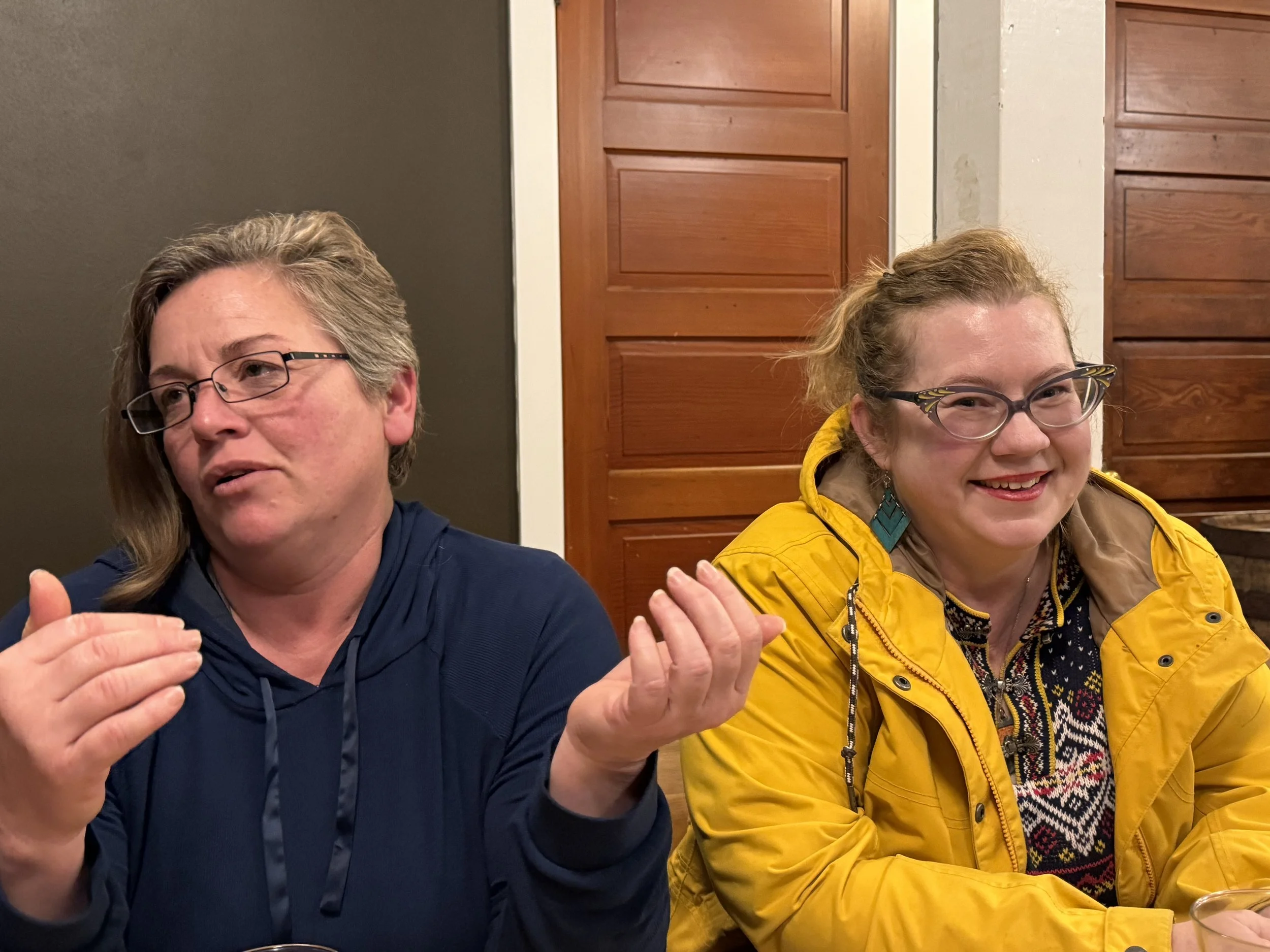
Ahsha and Sally
Does Consciousness Decompose?
Jon brought in the idea that our bodies are constantly changing. He's read that about seven years is how long it takes for everything within us to be replaced. But consciousness survives that process. And he wonders: will consciousness survive the not having of any material, having no body?
Seth saw the Ship of Theseus problem in what Jon was bringing up. What the Greeks say is it’s not so much the material as the process that makes the ship what it is (the ship is shipping, David!). The ship has the same crew, same course, and they're sailing on the same journey. The body is changing, but it still has continuity. We can't remember the vast majority of our lives. A bunch of us in the room have lived a billion seconds (31.7 years), but if you ask any of us what we were doing on second number 126,254, most of us don't know (not just because we were only 35 hours old either). This is true of most of the seconds of our life. We don't remember most of it. So what is it that drives the continuity? There are different ways of thinking about it. It could be the byproduct of a soul. It could be our antenna to the universe picking up an identity. There are a lot of different ideas that have been suggested towards this.
Thom has been reading Crick (what did I tell you! Here’s the evolutionary biology take ;) and was thinking that Crick would probably think consciousness is the philosophical dimension of biological life. Thom wondered: is consciousness or hope the last thing we lose before death? We know when our bodies are dying and decomposing, but how does consciousness—and does consciousness—decompose?
Mushrooms, baby! (imagine mushrooms that decompose consciousness - do NOT insert a magic mushroom joke people)
With what we've been working through for the evening, Seth saw how we could be looking at death through the idea of meaning. We could look at death through the lens of cosmology. We could look through the lens of consciousness. And in response to how Thom was asking about consciousness decomposing. It kind of depends on how you think of consciousness. If consciousness is only what you're experiencing, then yes, when you stop, it does. But is that all consciousness is? It seems like individuals are only the tip of the iceberg. Biology makes it possible for us to experience it, but it's not all that consciousness is. Consciousness could be a larger principle at work in the universe and it’s in everything.
That reasoning or school of thought is called panpsychism.
The Fruit Tree Cemetery
Luka said he always wanted to start a cemetery with fruit trees instead of gravestones.
The group was keen on this idea.
Andrew asked if you'd need to feel guilty about eating the fruit.
I said, "Only for the first twenty years."
Seth shared the book The Tenth Good Thing About Barney. He summarized the story for us and in the end that the tenth good thing about Barney is he’s in the ground helping grow flowers and, “that’s a pretty nice job for a cat.”
Max really liked Jane's idea about urgency. That idea was sticking with him. It seems like part of the experience is the people around death. He connected Andrew’s idea about culture choosing how we act toward death, and one of the things people do is want those who are dying to hold on and to stick around longer.
Seth asked, why do you think that happens?
Max thinks there's a physical aspect of wishing that that body was still there. We wish that there was someone, something material that we could still hug. He thought about the book A Monster Calls. It's about the experience of guiding the main character through their mom dying of cancer.
Max was thinking that part of the difficulty of death is that it is a collective experience. And there's this interesting part where we want to hold on to the last thing that was there. He shared his experience of his grandpa telling him what a good kid he was before his grandpa passed. Max told us the sort of things that typically came out of his grandpa's mouth before he died, and those weren't the things that Max held on to. What he held on to was his grandpa calling him a good kid. Maybe a talk for a future Scoundrels session could explore the shift we see in people near death - why or how does proximity to death change people?
Can You Be Aware of Your Own Death?
Pete told us about the end of his mom's life. There's this strange dichotomy between our bodies and our consciousness. His mom had dementia, and in the end, the person in front of him was a husk. The worst thing, he felt, was thinking that her consciousness was trapped in a husk. Which made him think: can you ever be aware of your own death? Can you die if you're not self-aware?
Seth said this ties to the idea of the absolute and the change of a person to a person, a star to a star, a moment to moment. Any of that ceases being. And in this way, every death is sui generis. We are and all there is, is absolute change.
What Max shared about hanging on to the kind moment with his grandfather reminded Asha that in Greek mythology, the gods were jealous that humans could die because it made every moment more precious.
Eric’s dad died on his dad's birthday, and he thinks that it was intentional. So Eric wondered: if we might be able to intend our deaths, is it possible that we may have intended our births?
Isa brought the conversation to a close, musing that if we were all buried under fruit trees, doesn't that make death obsolete? Death shall have no dominion. The world cannot do anything but proceed.
Fascinating Questions to Keep Chewing on
If death is the end of change, then what is change?
When an idea goes on, how does that happen?
Why do we keep picking versions of death that are so disruptive in our culture?
What's the role of death on a larger scale, like in the universe?
Will consciousness survive having no body?
What drives continuity?
Is consciousness or hope the last thing we lose before death? Or something else?
How does consciousness decompose? Does consciousness decompose?
Why do we want the dying to hold on and stick around longer?
Can you ever be aware of your own death?
Can you die if you're not self-aware?
If we might be able to intend our deaths, is it possible that we may have intended our births?
What we Know we Don’t Know
Here we were again, strands braiding together around a question that has no answer, experiencing it singularly but together.
Death might be the end of change or just more noticeable change. It might be the end of Pete-ing and Seth-ing. It might be a cultural decision about which indicators matter. It might live in the hearts of the living. It might be consciousness trapped in a husk or consciousness as the tip of an iceberg. It might make the God’s jealous because it makes every moment precious. It might be what gives all our endeavors meaning.
It might be grotesque when we hold on too tight to a single virtue or vice, becoming Serafina banging cabinets at an ex-husband for eternity. Or it might be what allows good ideas to persist while castle philosophy fades away.
What I do know is eighteen people showed up on a Wednesday night to think together about something utterly beyond comprehension but entirely real. We talked about fruit trees and dementia and mushrooms and Willie in the Bardo and how you hold your chopsticks. We held Max's grandfather calling him a good kid. We held Jan's mother-in-law apologizing in a warehouse dream. We held Pete wondering if his mom could be aware. We held each other's thinking.
Maybe the true tomb of the dead is in the hearts of the living. Maybe we're all headed for fruit trees. Maybe death shall have no dominion and the world cannot do anything but proceed.
Shout out to the quiet ones Robert, Carol, Dale. You brought your own energy to the wondering.
Join us next week for "Can music express truth?" Wednesday at 5:30 pm, Bridge & Tunnel Bottle Shop. Talk. Think. Belong.
