
Philosofishy in the House Tonight.
Scoundrels Discussion — 4.01.02026
Before Seth said a word, Jan made a request. She wanted us to go around and say our names. Given that we were about to spend ninety minutes asking what a community is and what holds one together, it seemed like a good place to start, and so that's exactly what we did. Precisely one name at a time, no more, no less, much to the relief of our introverts.
Welcome to Cameron, who I first spotted at the library, studying Math and graphics day after day. He seemed like the type who’d appreciate a weekly excuse join a group of thinkers wrestling with ideas out loud. Welcome to Sarah, who's been coming to the Aesthetics class and made her Scoundrels debut last Wednesday. And welcome to the fish people, who are not new, but are newly knighted and of whom more will be said, at considerable length, before this reflection is finished.
Seth kicked things off by announcing there wasn't much to unpack and he could just turn it over to the group…yeah right. You know he had more to say than that!
He proceeded to ask a bunch of questions. What exactly is community? Is it a group? Is it an event? What's the criteria, and who gets to set it? Where is community? Is it in space, in the minds of the participants, in time? Is it less an object and more an event, something like music that emerges from sound? And who decides what constitutes community — does that come from the inside or the outside? He pointed to the Chinook people, recently denied federal recognition again by an outside force and who know exactly who they are regardless of what any external authority decides. And why do we build community in the first place? Why do we commune? There seems to be something integral about it, something that touches identity, values, understanding.
For something with not much to unpack, he brought up kind of a lot. Typical philosopher.
Jane led us in. She noted that we'd shared our names, that none of us are required to be here, that for some it's easy and comfortable and for others it takes more effort. There are steps to traverse, it conflicts with other things, showing up costs something. And yet, week after week, something brings us back. She saw in this that ideas themselves are an important element of community. We don't tell each other our stories, not primarily, but we do get to know each other. We're here for the ideas.
Defining the Thing
Cameron, fresh from the library, opened with the dictionary: a community is a group of people with a shared goal. Seth asked what it is within that definition that makes it workable. The ensuing time made clear that there are at least three candidate ingredients — goals, values, and intentionality — and that people mean very different things when they use any of them.
Tim announced he was holding off on a rant. He had notes. I have a photo of his notes. The rant was coming.
In the meantime, his two cents were that we have a built-in desire for community. It is hardwired into us as a species.
I pushed back on the shared-goal framing, though not because it's wrong exactly, more because I don't think it must be the case. Our community shapes our identity and our identity shapes our community, and it seems like community is actually prior to our sense of self, not the other way around. We're part of many communities — chosen ones, default ones, families (which might be a subset of community or might be a fundamentally different thing, I’m not sure) and those communities shape who we are before we've had the chance to set any objectives. Goals can certainly be part of what holds a community together. I just don't think they have to be. (Check me out writing things down AND talking. I’m a woman of many talents.)
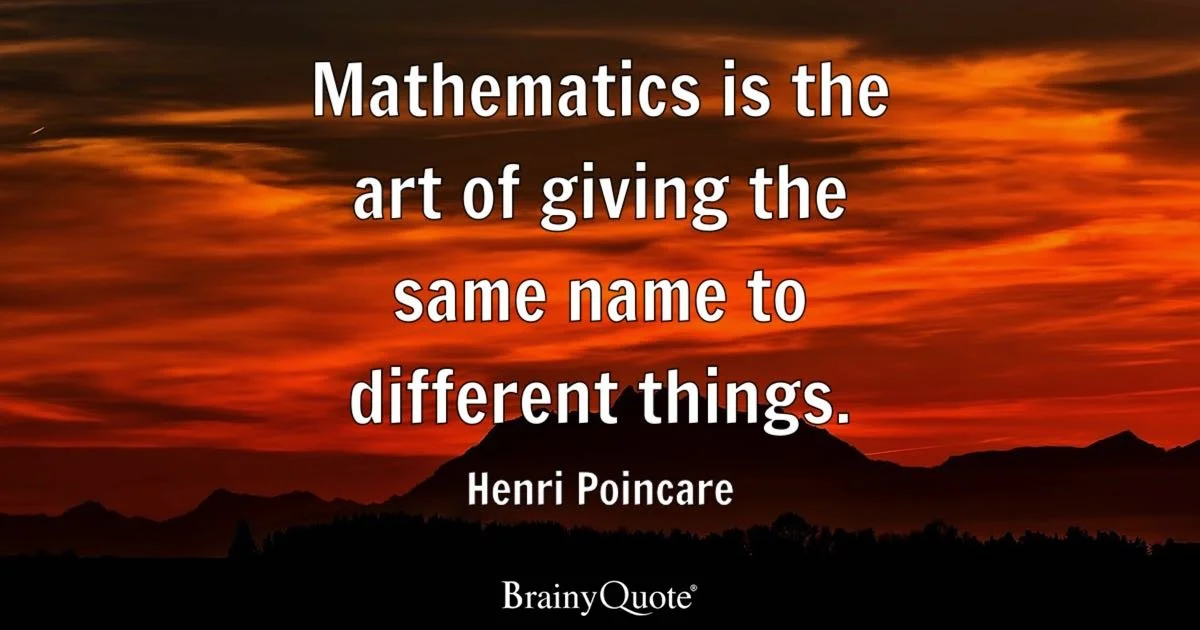
Seth thought about intentionality as another candidate, and Cameron brought up a pair of quotes: one about mathematics being the art of calling things that are different the same, and one about Galileo, who when threatened with persecution quietly said yes, the sun orbits the earth, whatever you need, and then turned his back. The community was placated. He remained. Cameron was probing something about what community requires of us, and what we do when the cost of dissent is too high.
Seth also drew on Derek Parfit's Persons and Reasons, where there's an argument that there's no such thing as a person — only stories of continuities. In which case a person is, in some sense, already a community.
The Spectrum and Its Dangers
Andrew was interested in why we aren't drawn toward isolation, and in what health has to do with belonging. We live longer in community. Alone, he surmised life gets scary, destabilizing, and hard to make sense of. The shared-goal definition resonated with him, but he noted you can take it too far. A community organized around a sufficiently rigid shared goal can begin pushing out the needs of individual members. It can tip into cruelty. Which raised the question: is a cult a community? (and Don wasn’t here for it!)
Seth framed it as a spectrum where on one end is total isolation; on the other, complete amalgamation. At either extreme, something is lost. In the middle there's a sweet spot where a person can be a person inside a community. The question is how exactly do we slide off that center?
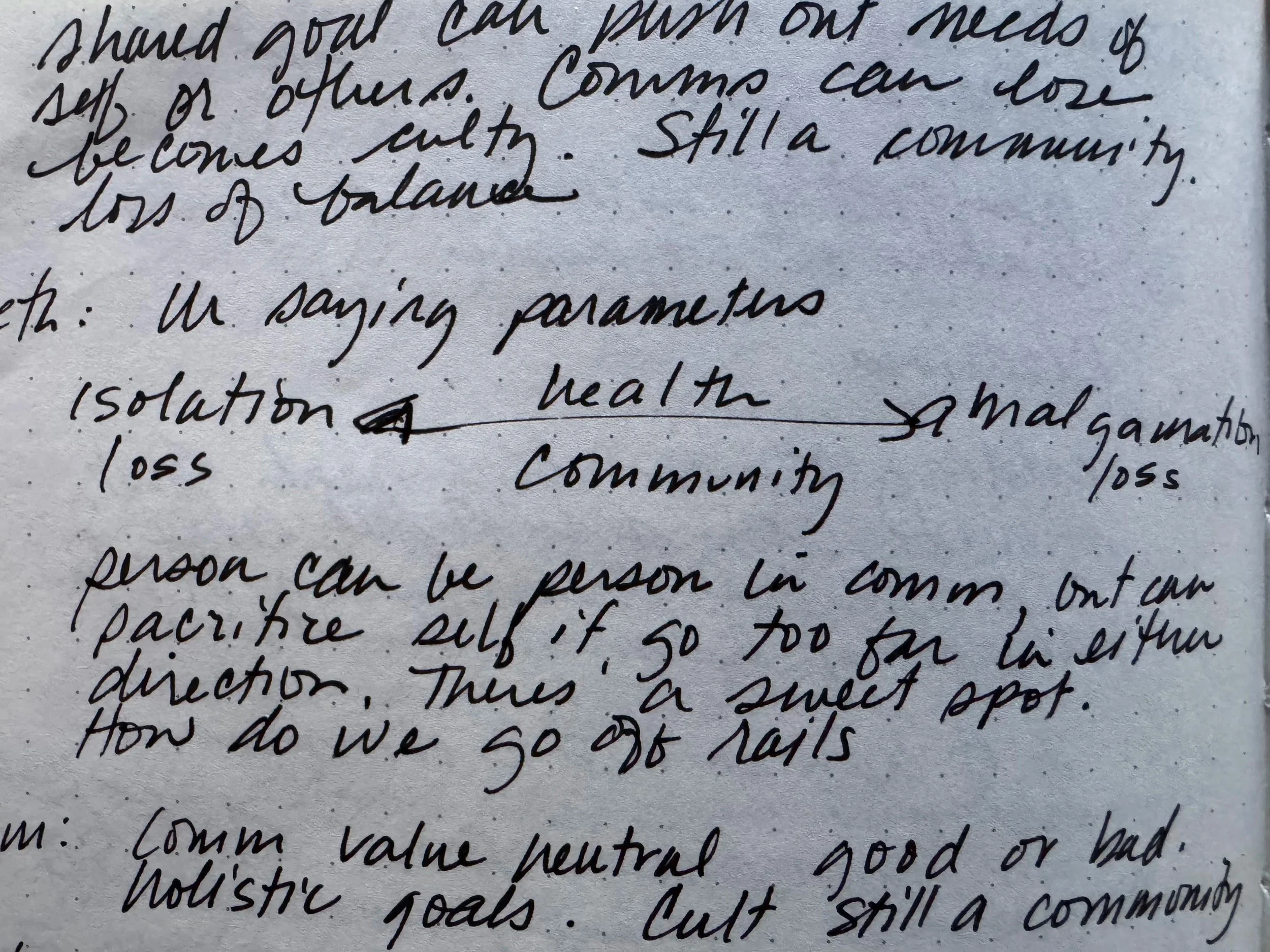
Tim took the position that community is value-neutral. It's not inherently good or bad. The Nazis were a political party and they were still a community. The scope of communities can run from evil and horrifying to beneficent and wise, and those characteristics aren't at the heart of what makes something a community. And then he teased his upcoming rant.
Andrew wasn't convinced. In a genuine community, individuals retain agency and continue to engage. In a cult, agency disappears. That distinction seemed meaningful to him.
Jan added another layer: you can be inside a community and unable to leave, not because you'll be killed, but because you'd be ostracized and that cost or risk is too high for many. Which raises the question of how much of what we call community is held together by belonging, and how much by the fear of its absence.
The Croaking Fish Rebellion and a Rant
Jim introduced himself as a fish person. Specifically, he likes to say he's in Astoria because of the fish people, and through that community he met Cierra, which is how he ended up here at philosophy club. One community led to another for Jim. The fish community is strong in our town, others not so much. It can be harder to find a sense of belonging if your entry to a new place doesn’t put you in connection with others that share values or interests.
Tim had been holding his notes. The time had come.
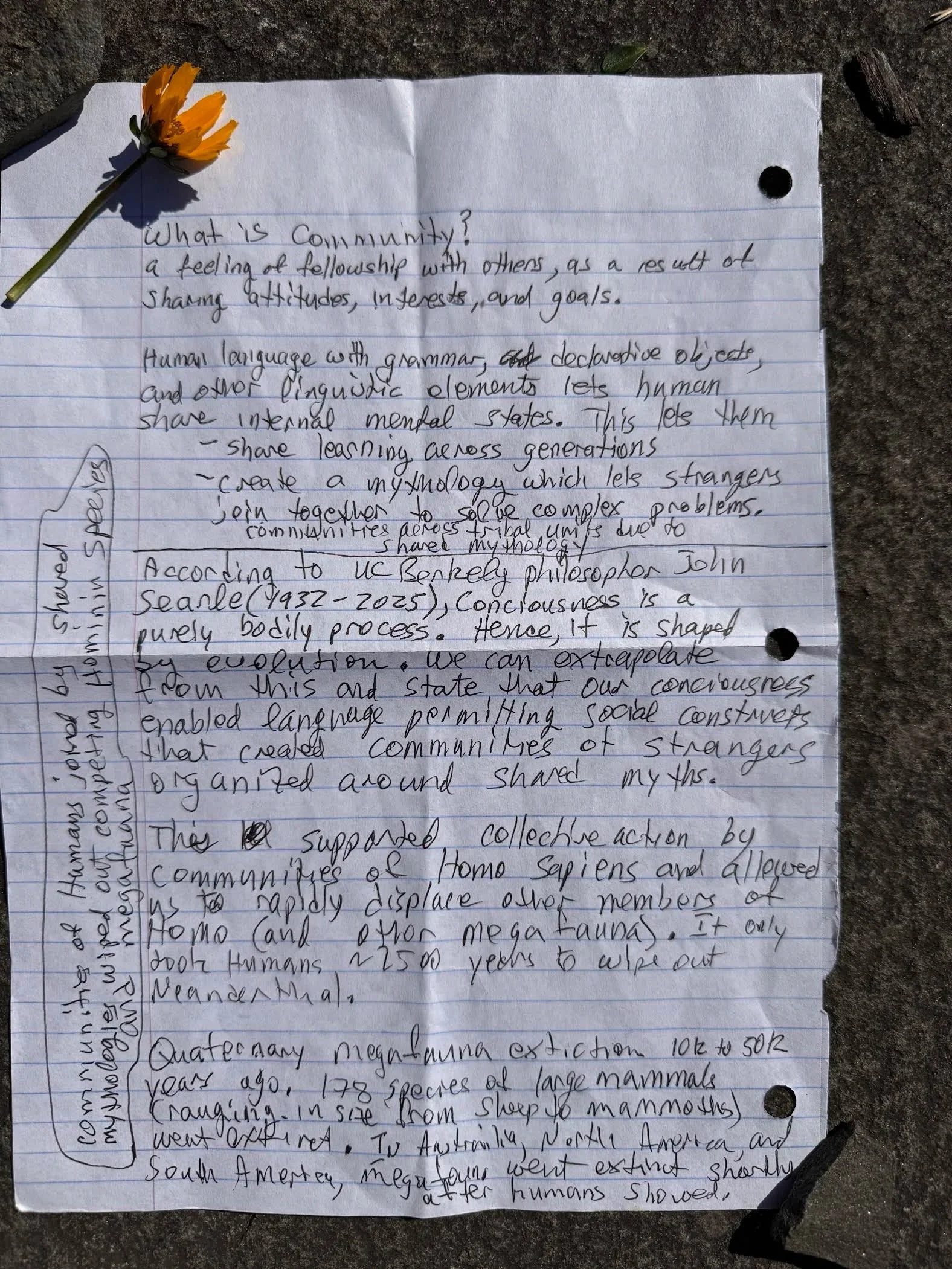
Drawing on UC Berkeley philosopher John Searle, who argues that consciousness is a purely bodily process shaped by evolution, Tim worked through the following: consciousness enabled language; language permitted social structures; social structures created communities of strangers organized around shared myth; and it was shared myth that allowed homo sapiens to do something no other hominid could. They could share learning across generations, coordinate at scale, solve complex problems as strangers. The myths were powerful enough to build communities beyond the tribal, and that capacity is what allowed early humans to so thoroughly displace other hominids and megafauna.
The takeaway: our communities are held together by shared myths, and this is one of the defining features of our species. We evolved community beyond tribalism, and at this point the need for it is hardwired. We feel incomplete without it. Community is part of what we are, not something we opted into.
Le Gran Rant
Jane said this sparked an image for her: schools of fish, and what it might mean that they gather and organize the way they do.
Tim held the intentionality line. Community, in his view, requires cognitive choice. He wished Bob were there (Bob is rehearsing his role as Tigger for a play across the river), because complexity theory can entirely explain and predict the behavior of a school of fish — and if a behavior can be fully accounted for by complexity, does it meet the bar for community? Tim doesn’t think so. But he also acknowledged this might be his mammalian privilege coming through.
Jan was not having it. "Humans would think that," she said, playful, but serious. Her point: we've got no business telling other species what they can or can't do. And if anything, she argued, humans may have the narrowest sense of community of any species. Other animals respond to environmental stress in ways that account for the larger system they're part of. Some will go so far as to kill their young to keep the broader interdependent community in balance. Humans, largely, don't think at that scale. Our sense of community tends to be bound to each other, not to the web we're embedded in.
Jim came back to rep for the fish. Rockfish can live to be 150 years old. They vocalize. They interact. Calling that not-community didn’t sit well with him.
Nathan, another fish person, brought in the ethnobotanical lens. He pointed to a book called Cod (not to be confused with A Fish Called Wanda), which looks at human history through the lens of one particular fish. Entire wars have been waged over cod. The relationship between humans and fish, across centuries, is itself a web of interaction and interdependence. Something we've been calling a community. Narrow the frame and you get a school of fish. Widen it and you get something much older and more complicated.
Seth noted that in the web of life there's a vast array of species all navigating survival together, and that whether community is a general property of many organisms or something specific to humans is itself a real question. Is a hive social but not communal? Is community a deeper concept, or are the animal versions analogous but not the same?
Thom was thinking about swallows, who seem to work together without an obvious leader, and geese, who definitely have one. Does human community require leadership? Or maybe direction is the better word. Is community something that needs orientation without necessarily needing a person at the front?
Community in Time
Jane was thinking about rituals. Community is where we belong, and we don't have to live in it all the time to belong to it. We can hold space, come together over time, and commune when we do. What she sees fading is the ritual of waiting. When we deliberately gather after an interval that builds another kind of community. It's so easy now to start a Zoom or fire off a quick email. The holding of space is getting replaced by constant contact that somehow adds up to less. When rituals of gathering do remain, she said, there are ways of communing that are rich and deeply fulfilling in a way that the faster substitutes don’t approach.
Tim agreed and shared he's been part of a supercomputer group for 35 years. They’ve been meeting annually over the decades. He cherishes it. He's also been watching Pew data on religious participation, which showed around 90% of Americans engaged in the 1990s, down to around 60% now. He thinks this is entangled with the relationship between religion and politics, but he also flagged something interesting in the numbers: a growing population of men between 18 and 35 is turning toward religion, particularly the Catholic Church. He believes this resurgence may be a result of how few places there are to commune. The institution isn't necessarily the draw. The gathering is.
Seth closed with Alexis de Tocqueville, who in Democracy in America, written in the 1830s, asked why the United States succeeded with democracy where France failed. His answer centered on the strong club system. People coming together around shared interests, forming the connective tissue of civic life bolstered up democracy in America. Whatever community does, Seth said, it must be preserved meaningfully going into the future.
A Person Is a Community
Jan, who had earlier argued that humans might have the narrowest sense of community of any species, turned the lens inward at the end of the night. She thought of herself as a plant, an animal, a mineral. Within herself she is a community: her organs, the biomes living in and on her, the systems in constant relation. There are multiple levels of community inside a single body, all interdependent, at a variety of scales. The boundary of where community begins and ends is not where we assume it is.
This looped back to what Parfit was doing when he argued there's no such thing as a person, only stories of continuities. If that's right, the line between a self and a community is already blurry before we've asked any of the bigger questions.
Jan also offered something about movement: if we evolved from something, then we're still evolving. There's a becoming-ness at play with community. It isn't a fixed structure we join. It's something we're inside of and something inside of us, both of them in motion.
Isa reflected that many of the communities she considers most important she would also call families. Many of us have chosen families. To be a person is to be part of several communities, and with what Jan said, to be part of an even bigger one than we usually remember to account for. Interdependence might be what community actually is underneath all the definitions we tried on.
Sushi on the Plate
Does community require intentionality?
Is a cult a community? What is agency? And what is the role of agency in community?
How do we slide between isolation and amalgamation?
If behavior can be accounted for by complexity can it still be community?
Does human community require leadership?
Is community uniquely human or a broader property in the universe?
What We Know We Don't Know
We don't know if community requires intentionality.
We don't know if the rockfish living 150 years, croaking in the dark, constitute a community or a complexity equation. Tim thinks there's a difference. The fish people are not convinced. The fish, presumably, have opinions.
We don't know where the self ends and the community begins.
Maybe community is prior to everything we said about it. Maybe the goal comes after, and the myth comes after that, and the intentionality comes last, well-dressed and taking credit.
Maybe the young men finding their way to the Catholic Church are looking for the same thing we're looking for on Wednesday nights and just found a different door.
Maybe a cult is a community and maybe it isn't and maybe Andrew and Tim will become a community of two trying to figure it out.
Maybe squirrels are planning further ahead than we are.
Maybe we are all, at every scale, fish.
Big ups to our quiet ones Sarah, Javi, and David. Jan, thank you for asking our names.
Join us next Wednesday at 5:30 at Bridge & Tunnel. Bring your schools and your myths and your mammalian privilege. We'll ask: Why do we hold on to Zombie ideas?.
Come think with us.
