
How Accurate can Language Be?
Scoundrels Discussion — March 25, 2026
Seventeen of us last Wednesday at Bridge & Tunnel, counting me and Seth, which we are doing now, you know how I feel about that. Jim brought a whole gaggle: Zach, Javi, & Nathan. We had newcomers who found us on the internet, which means something is working (it’s me). And many of our recurring characters were back. It was a big, lively room for a conversation about language. Yeah, guys. We talked about language.
Seth Points to Truthiness, Accuracy, and Language Types
Seth kicked us off with the different ways we might think about the question. We can look at the empirical, descriptive function of language, but that always raises the question: what is the relation between accuracy and truth? What does accuracy even mean in the context of language? Language can give us a pretty good idea of what we're talking about. It can work with objects and describe their functions. But depending on how we look at it, it changes how truth works. Are some languages more accurate than others? In philosophy there's a distinction between natural languages and formal languages. Is one more accurate than the other structurally? Is writing more accurate than speaking? If accuracy is part of the issue, is it possible for language to ever be completely perfect? There are different ways of talking about accuracy, and what any of them have to do with truth is its own question. Is truth and meaning the same thing? Can something be inaccurate about a truth but still have meaning? And why should we care about this at all? What does accuracy do? He also brought books. Two of them. We'll get there.
Dead Languages and the Living Problem
Jim, trained as a biologist, brought up Latin. In his field, Latin is used specifically because it's not a living language. It doesn't have slang. Naming something in Latin means the meaning of the words won't drift over time. A flower fish stays a flower fish. The language's stillness is a feature.
Seth philosophized that this implies the accuracy of language isn't necessarily the language itself, but how it's used.
Zach jumped right into the fray. Welcome, Zach! He's also familiar with Latin from his scientific background and saw that the training he received came with a whole package of assumptions, immutable protocols for accuracy versus precision in specific contexts. Language is a tool for specific use. But he finds it interesting that the tool only goes so far. It requires guardrails to function for this specific use.
Tim, who is not fluent in Latin but does have friends who are, had been hanging out in Italy with a Catholic buddy who was singing the praises of Latin as perfect for law because it lacks grammatical ambiguity. Tim hadn't realized the structure of Latin was designed to resist ambiguity. Seth confirmed: it's tight, five cases, well-defined tenses. Not exactly perfect, some notoriously irregular words, but when you do get to eloquence in Latin, like Cicero, you have to start doing things cleverly within the language. Seth found it interesting that doing more with Latin means you have to start twisting it.
Pre-Brew
Don was back from his adventures in California and wanted to know what the question was. (This became a refrain through the evening for Don.) His first instinct was that the question seemed redundant, because if language isn't accurate then it's just noises we’re making. He was thinking about how our minds are constructed from language, the Sapir-Whorf hypothesis, and the idea that there was a perfect language before Babel, presumably Hebrew. And guys Don has been waiting to talk about the Tower of Babel for at least six months. I am honestly a little surprised he didn't dig in deeper. But what had happened was that when the idea of a perfect language before Babel came up, somebody blurted out "pre-brew," and the thought process was derailed by group laughter.
Don also talked about how speaking another language changes the way you think and relate to other people. Different languages have cases and tenses and grammatical structures that force you to consider your relationships with others in ways that a single language doesn't require. He told an amusing story about being in the Czech Republic teaching English, having spent his prep time in bars, so all his Czech was slang. Then he lifted up that Latin, like all languages, had someone deciding what was proper, what was slang, what was the pure form. That's not an inherent quality of the language. It's a choice made by someone with authority.
Seth followed the Sapir-Whorf thread from Don's musing and talked about the structure of the Hopi language. He doesn't know Hopi, but his understanding is that the worldview and the consideration of time are so distinct that connecting certain ideas becomes genuinely difficult.
On a more personal note, I’d like to pat myself on the back for following the Sapir-Whorf Hypothesis convo this time, instead of cracking up laughing thinking we were talking Star Trek like I did back in January.
To avoid Gadian-style mistakes, watch this.
Tim Has a Snippy Thing and a Deep Thing
Tim has had experiences with academic philosophers that did not go well. He struggled to communicate with some of them because they use language differently than he does as a scientist. I can't remember who was the fussier academic about how to use language in his telling of it, but he had a realization that the purpose and function of language for philosophers is different from the purpose and function of language for scientists (the whole lot sounds fussy to me ;). Once he saw that, he could communicate more easily.
Seth mused that perhaps Tim's description of philosophers had painted a bit of a caricature. For those reading that weren’t there - this was all very good natured. We joked about Tim’s self proclaimed snippy bit. Seth also lifted up that philosophers do recognize the necessity of clear, delineated language. Philosophy looks at how language does many things at once: it does science, it does poetry, it can talk around something, it can obfuscate and confuse. What's philosophically interesting is that language can do all of those things, and some of them seem to be in contradiction with each other. It's strange that this thing we call language holds a mystery about what it even is.
Then Tim had his deep thing: the math of AI and large language models, which is his area of expertise (he apologizes for helping build the internet, too), doesn't actually have a working theory for why they work. Wolfram hypothesizes that if we ever do figure out how AI works, it will also expose how language works for humans. Seth was familiar with this idea that we may learn the emergence of language comes from deep logical structures we currently know nothing about.
David Dismisses Truth
David is like our solid, quiet presence. He waits for a few ideas to float around the group and then looks at how they fit together, almost always putting them up against his own experience as a kind of litmus test. I love that he does this. Also his voice is cool, kinda gravelly. When he talks people lean in.
So. David maybe knows five Latin words, and most of them don't mean anything to him. He can speak some shitty Spanish (his words) and worse French. Latin is effectively meaningless to him. He works in computer science and is familiar with Chomsky's hierarchy of language, which gets used in his field. So he was thinking about the way free language and finite state machines interact. Computer guys in the building, folks. So he sees how formal language adds more and more rules, but in the end it doesn't matter how accurate a language is if you don't know it. If Latin were capable of ultimate accuracy, it would mean absolutely nothing to David, because he doesn't know it. The truth would mean nothing.
He kind of dropped a bomb here. He took truth out of the equation by pointing to the relationship that language has with the person who knows it. There's an exclusivity to language. What would it mean for a language to reach truth if the people it could reach truth for are an arm's length away, and they have no arms?
Seth unpacked Tarski and Donald Davidson at this point. Tarski's semantic theory of truth says we shouldn't ask what language is — we should ask how true it is. Davidson responded that this is where the difference between formal and natural languages really matters. For formal languages, Tarski is absolutely right. But natural languages are different. Within human experience, there's something referred to as the primordial notion of truth. It's so deep it can't actually be defined in language. Formal language can keep working on its own accuracy because it can continue to refine itself from within. Natural language, because it lives in human consciousness, proceeds differently. What does accuracy even mean if it's entirely dependent on one's experience?
The Crow-Ole of a Factory
This reminded Jim of his experience with factory language, the creole that forms when people can't hear each other in a loud environment, where gestures become fluent and a person who speaks Tagalog and a person who speaks Russian and a person who speaks Spanish all speak Factory. He was wondering how these ideas fit with what crows do: they fly, they land, they eat, they have sounds for all of that. How does the factory creole fit together with the idea that crows can communicate a world of experience with three pillars of sound? (we didn’t even mention sound! So many conversations to have, so little time on a Wednesday night).
Seth reached for his other book and Jim said, "I love it when I trigger the next book."
If you’re looking for a bedtime story…
The other book was Wittgenstein. He summarized the early work to let us know Wittgenstein changed his mind later. In later Wittgenstein, language is like a game. What he developed is that meaning and engagement arise together. For the operations of language to work, we treat each other in a particular way. There's a lot that can be achieved through the game-playing aspects of language. So my takeaway here is Jim was playing games with language at the Factory. And by the laughter that Jim shared with Nathan about Factory speak, this seems like it might hold a little water.
What the Island Knows
Jan was thinking about how some indigenous and African languages are more specific and accurate to the natural world. How there are many words for snow in languages native to polar regions, for instance. And that got her thinking about our eurocentric way of considering language. If we're using this eurocentric language to think about thinking, how much is left mysterious because the language being used doesn't have the advantages or insights that other languages possess? Which isn’t exactly how she put it, but it was definitely what she was pointing at. Dang people’s thoughts are interesting.
Jim saw this connecting to the question of accuracy versus precision.
This brought one of Seth's students to mind. Latham joined the Peace Corps, ended up on an island in Vanuatu called Aneityum, fell in love with one of the chief's daughters, and now has a lovely family. His observations about that language are interesting because it's not so much that the language is more accurate as that it's limited to the island's grammar. As specific as referring to a particular rock. You don't know if it's more accurate, but it has ways of making it work by focusing on the livingness of itself in its place. If you wanna take a deep dive into Latham’s thinking, you can check out his dissertation CANOES, KAVA, KASTOM, AND THE POLITICS OF CULTURE ON ANEITYUM
Speaking of islands and language Zach worked in Hawaii for a while and saw this kind of place-based specificity there too. The context of the language is critical. Species names in Hawaiian languages match nearly exactly what biologists would name through Latin, relying on the same features, because the language itself has developed in the same environment. Then he was thinking about how the writing, the art, the poetry, the mutability of a language is critical to maintaining meaning. Hula, he said, has maintained its meaning within the place-based understanding. There's a lot of work put into maintaining specific meaning-relationships.
I know this tickled Seth's fancy because he studied in Hawaii for his PhD. He talked about how hula traditionally comes with a chant, movement and words working together to tell and keep the story. A mudra, like the mudras in India, everything more specifically indicative.
I was fascinated with the idea of maintaining language. What does maintaining a language do to a culture, to the people who use a language? Is there any way to avoid maintaining a language (other than it dying)? Does maintenance just look different depending on the culture and what’s considered virtue? I was thinking about how American English moves. It is extremely dynamic. We have slang specific to geography, demographics, class, race, gender. The language is constantly shifting and at speed too. I’m curious whether we could cultivate a language versus maintain one. What do we see in cultures that strive for stasis in language versus cultures where the language is purposefully cultivated to move and shift? So, there’s a few questions that got going in me. Enough for Zach and I to talk for a week straight probably, lol.
Zach shared the reason the Hawaiian language is being maintained with such rigid boundaries and methods was to reinforce and maintain the hierarchy in the past, because hierarchy was so important to that culture. And it's also what's happening as the language moves into the future, because the people reviving it are academics who carry the same motives and ideas of control. Language maintenance as power. Be still my little Foucault loving heart. Another quill to add in the quiver of biopower.
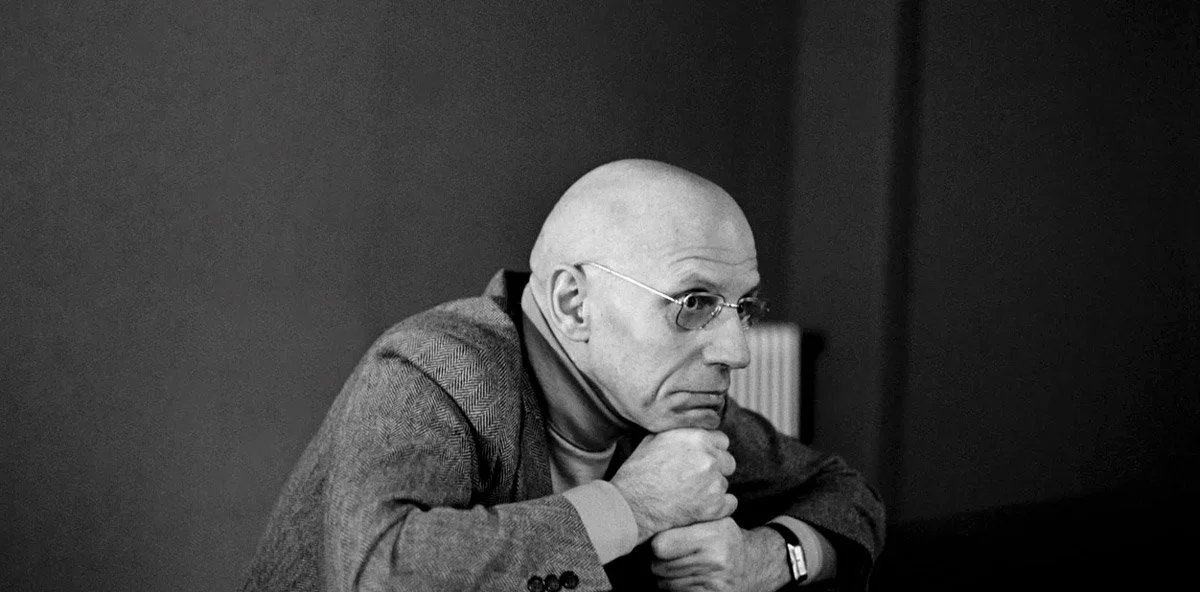
Foucault, my first philosopher crush (thanks Velvet and Hiro!)
The Finnish Friend and the Thought Before the Word
Jane's interested in the connections between words, meaning, and reality. She was talking to a native Finnish speaker about the topic and her friend shared that her brain language and her spoken language are different. She thinks in Finnish first and then translates. And there are thoughts she can think in Finnish but cannot say in English.
Which raises the question for Jane does the word precede the thought, or does the thought precede the word? She couldn't imagine naming a thought before having it. And I thought for sure we might take a moment to chat about the gospel of John at this point…In the beginning there was the word. And I didn’t even think of one of my other philosophical loves of stoicism and the logo spermatikoi, but now I’m just dropping philosophy concepts. Excuse me sir, I dropped a little Arche.
This also brings up, as Jane noted, the total absurdity of being told to think before we speak, since we can't really figure out whether that even makes sense if we don't know which comes first.
Does Language Have to Have a Relationship With Truth?
Lowell was thinking about the way language has been used just since he started coming to Scoundrels. Everyone in the room can look at the dartboard and pretty accurately describe it. The description of the color of the room gets grayer. (Funny because the room is brown…to my eyes) He was reflecting on how last week we were talking about words like justice and freedom. And then he was piecing in where language fails him: talking about art, or love, or why he plays music, what music does for him. What does Michael Jordan experience when he knows he’s not going to miss a shot? How would MJ begin to put that in words. Words for pain don't work well. Language really fails us in the midst of the human experience. Some things it can be very accurate about. Others, it can hardly even scratch the surface of.
Seth came back to Wittgenstein: language makes pictures, and logical space. The last chapter of the Tractatus is one sentence: whereof one cannot speak, thereof one must remain silent. People really misunderstood that line. They interpreted it to mean that without logical structures underpinning language there can be nothing meaningful. Wittgenstein's response was that they were totally wrong. The point was that there is much we experience that we cannot say, and it remains in silence. Lowell was having a real Wittgensteinian moment.
Tim liked how thoughts that are in silence implies our minds are open to more.
And then he wanted to talk about a guy who had a deep influence on the creation of Java, Guy Steele. Who once gave, in Tim's experience, one of the best talks about language. The talk started with the premise that any word with more than one syllable had to be defined. He gets deeper and deeper into complex computer ideas, defining every new word he uses. And because every word along the way has been defined, deeply abstract ideas unpacked later are easily understood because everything is built on known definitions and assumptions. Tim liked the idea of practicing writing through an idea and defining every word before proceeding. He thought this was obviously not something we can do day-to-day. But it's a good practice.
And for someone traumatized by philosophers in academia this sounds an awful lot like a romantic idea of a philosophical practice. Look at the assumptions behind the words we're using and define them before moving forward. Also, Tim was so moved by the quality of Steele’s talk that he wrote down the name and passed me a note across the table. If you want to swim in the waters of formal language, Tim highly recommends this video.
Recommended by Tim.
Thom brought up the fact that we skipped talking about words themselves and had gone straight to truth. So he wanted to know: must language fundamentally have a relationship with truth?
Thom's questions a year and a half ago were more like: what the heck does this have to do with the kickoff? Now he brings up underlying assumptions in the conversation and asks about them. We might have a philosophy pirate on our hands! It’s a movement, Thom.
Seth said language doesn't necessarily have to have a relationship with truth. The reason he framed it that way in the kickoff is that when we ask about accuracy, there seems to be a presumption that there is a truth to be accurate about. There’s the taffy of philosophy getting pulled.
Half-Baked
Does language have to have a relationship with truth?
What does it mean for a truth to exist if access to it is gatekept by fluency?
What does a language's relationship to change say about the culture that speaks it?
Candor, Thom said, is just blurted out from the heart. Is candor language? Is it accurate? Is it true?
Tim's Java talk example. What would it change if we defined every word before using it, even occasionally?
What We Know We Don't Know
We don't know if formal languages are more accurate than natural ones or just accurate about different things. We don't know if thought comes before language or language shapes the thought. We don't know what the factory creole shares with the crow's landing call, though something in Jim's pairing of those two things keeps buzzing around.
We don’t know if the language of a place carries something that other languages can't touch. We don’t know if silence holds what speech cannot get to. And we don’t know what it means to maintain something versus let it move.
We don’t know about the croaking rockfish or the chemical speech of plants, spiders, ants, or bees because we ran out of time.
Big ups to our quiet ones Javi, Nathan, Jay, Christin, and Carel. Welcome to the table. And thanks to Zach for the Hawaii thread, I’m still cultivating it.
Join us next Wednesday at 5:30 at Bridge & Tunnel. Bring your words. Question them while you're at it. We’ll talk, “What is Community?”
